
Uppark House and Sennicotts
We visited the fifty-four acres of Uppark House on a damp day in September and having waited for the rain to stop we were taken on a tour by one of the long-time volunteer gardeners, David Edyvean. He explained that there was just one paid full-time gardener and one part-time, the work mostly completed by volunteers. Before the Covid pandemic there were between thirty and thirty-five volunteers and now there are only twelve.
From the terrace outside the coffee shop on a clear day it is possible to see the Spinnaker Tower in Portsmouth and as far as the Isle of Wight. At one time the coffee shop was the kitchen and as it was so far away from the house, tunnels were built to take food to the main building and to keep the servants hidden away. I do wonder how warm the food was when it finally arrived at the table.
Following the fire in August 1989, the garden was changed and large ornamental beds were dug and planted to provide interest for the public during the rebuilding. These beds have now been removed as they are not in keeping with the original garden. The latest project is to restore the historic pathway that once led the visitor on a journey around the gardens, with viewpoints along the way. The project will be financed by fundraising events and you can read more about the restoration here: https://www.nationaltrust.org.uk/uppark-house-and-garden/features/restoring-upparks-historic-path-network
In the woodland there are many snowdrops, fritillaria, wild violets and narcissi bulbs, which in spring put on a great show. We were shown some of the Norway maples and a Judas tree Cersis siliquastrum, said to be the variety of tree from which, having betrayed Jesus, Judas Iscariot hung himself. One of the other trees pointed out to us was Clerodendrum, which smells of peanuts.
David Bridges, a National Trust volunteer and SGT member, led the second tour and we saw some of the work that Humphry Repton undertook, following an invitation, in August 1810, by the owner Sir Harry Fetherstonhaugh.
Repton proposed many changes to both the house and the garden and we saw the evidence in the Game Larder which clearly showed the galleted flintwork and was designed to be approached along a cobblestone path with a pattern formed from knuckle bones. Another Repton feature was The Urn on the Mount which can be seen as you walk down the entrance path.
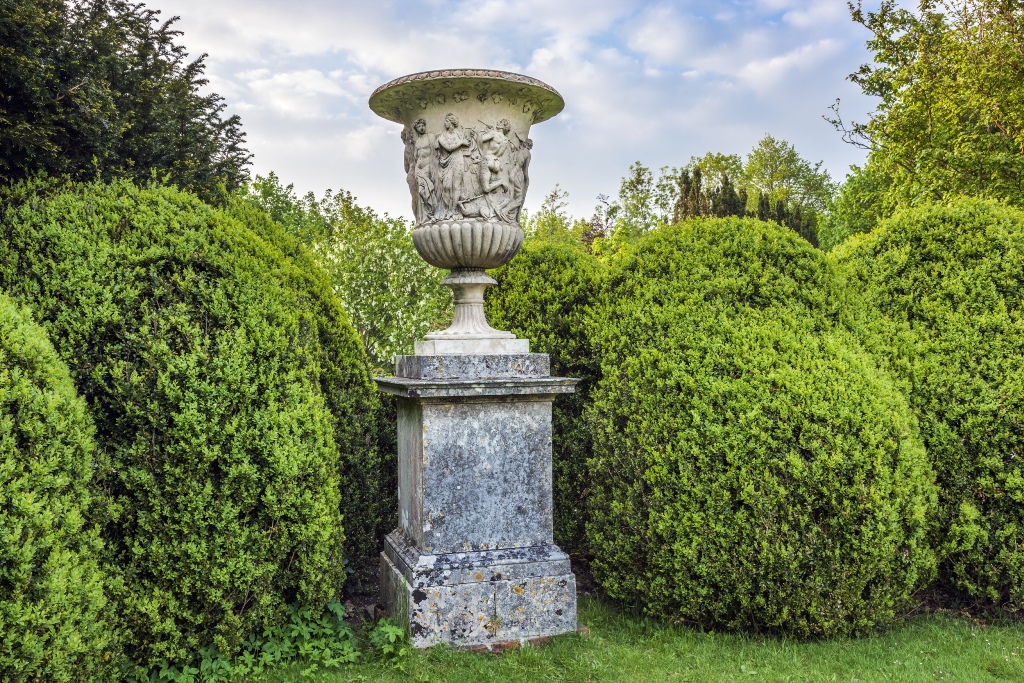
© National Trust Images/Andrew Butler
David told us a delightful story about Sir Harry who on hearing someone singing asked who had the lovely voice. On being introduced to a twenty year-old dairymaid, Mary Ann Bullock, he fell in love and asked her to marry him. He gave her time to think about his proposal and suggested that if his joint of meat that night was served with a slice cut from it he would know that the answer was yes. A slice had been cut. Sir Harry then sent her to finishing school so that she could learn how to behave as lady of the house. It was an unlikely combination as he was in his early seventies, but their union was a happy one and lasted twenty-one years till his death in 1846, after which Mary inherited Uppark.
©National Trust Images/David Sellman
We finished our interesting visit with lunch in the restaurant. As we had been invited on a day when Uppark is normally closed to visitors, the house was not open, so another visit is definitely recommended.
Report by Barbara and Ian Voller.
Sennicotts
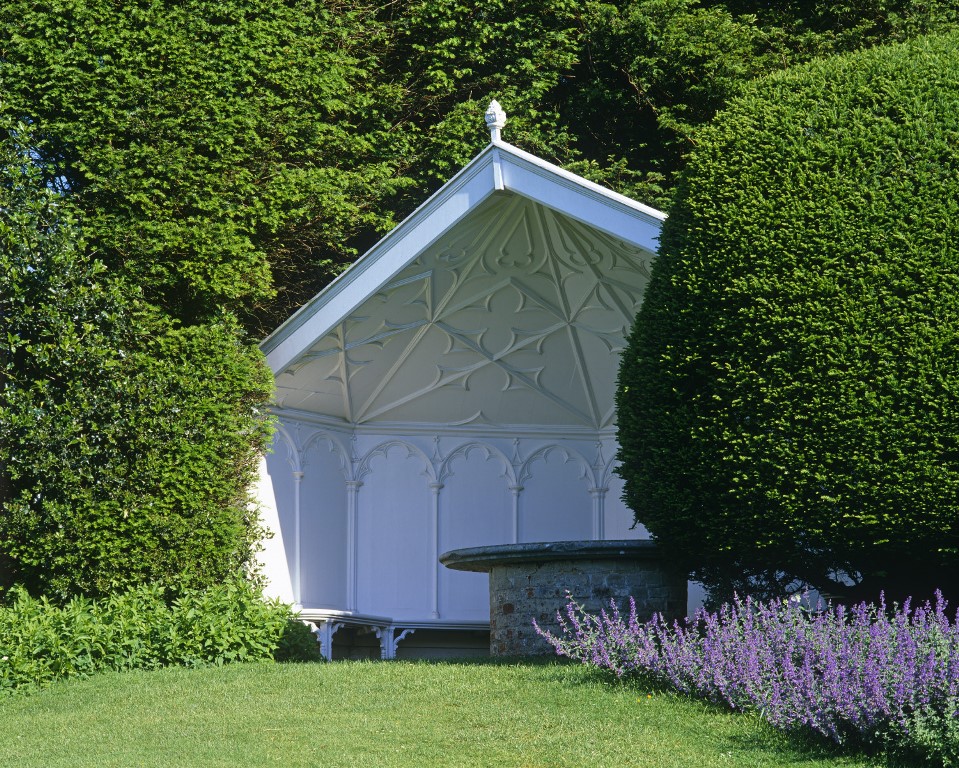
The earlier rain clouds had disappeared as we drove the short distance south from Uppark and through the small villages to the white gates to Sennicotts. We were welcomed by the owner, Eloise Rank, at the delightful summer house on the lawns and began with a lively introduction to the history of the house and garden. Eloise and her husband James inherited Sennicotts about twenty years ago, from his great-uncle, John Rank, and although at first they felt overwhelmed by what had to be done in the garden they set to, with a philosophy of ‘just go for it’. The house is Regency, dating from around 1810 with several notable owners, including the Prince and Princess Louis of Battenburg, who made it their first home after their marriage in 1884. It was then purchased by Geoffrey Bowes-Lyon and his wife who were keen gardeners. Eloise explained that the pair of lions on plinths on the lawn are their namesakes. Mrs Rowland Rank came to live in Sennicotts in 1960 and her younger son, John, lived there for over sixty years.
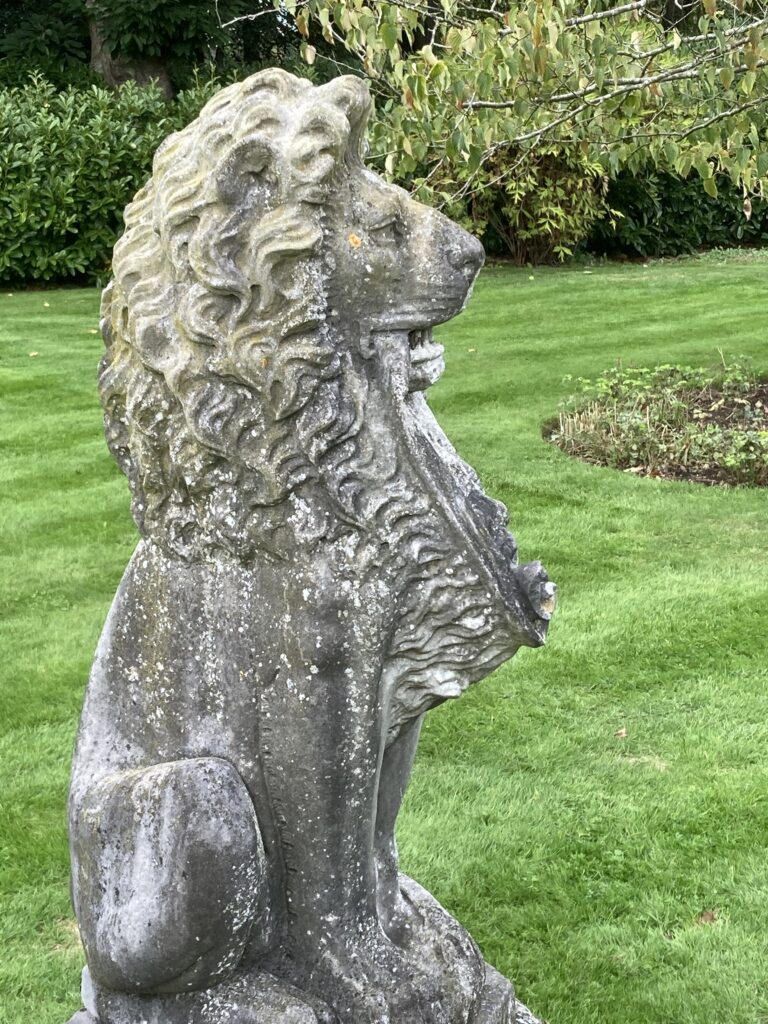
Photo by Sally Ingram.
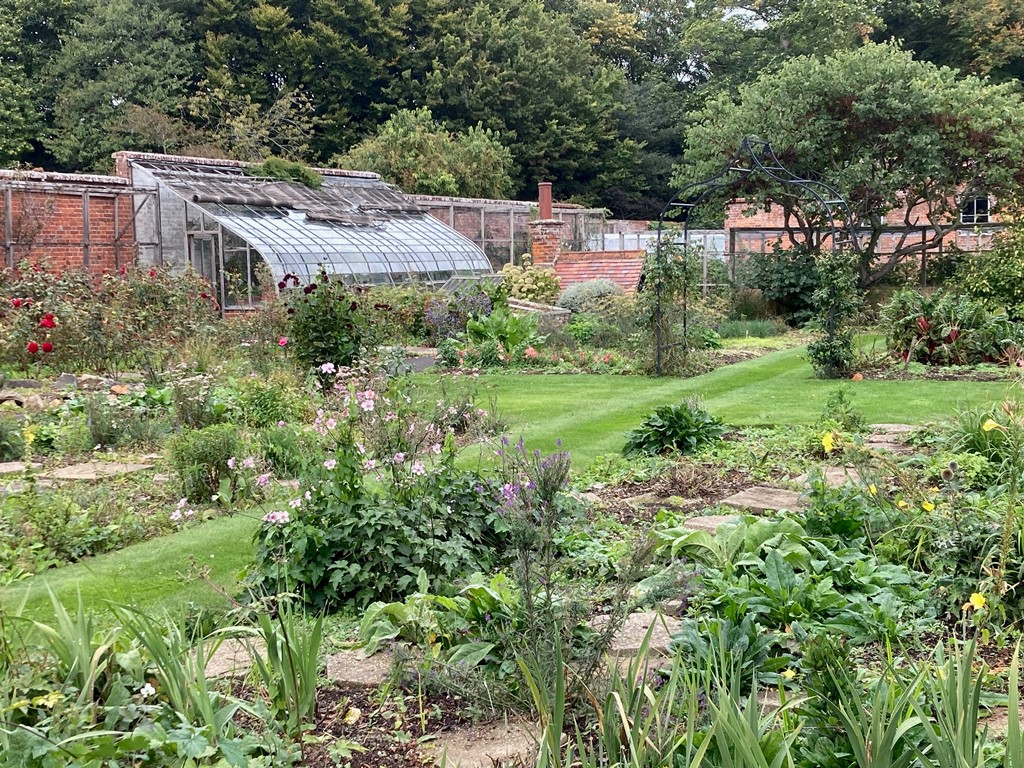
Many of the trees that we saw in the garden are original, including an impressive Wellingtonia and a sweet chestnut, called the Old Lady. At one time there was a laurel hedge in front of the house but this had become like a forest and was taken out. The original walled kitchen garden however, has been lovingly cared for and on the afternoon of our visit was full of the mellow colours and scents of autumn. There were laden apple trees, ripening fruits on the medlar, and figs growing against the old brick walls. A sweetly scented Styphnolobium japonicum, orJapanese pagoda tree, caught our attention with its attractive white blossom, and the last of the dahlia and roses added a splash of bright colour. Early maps show three greenhouses in the kitchen garden, but these have been lost over time and replaced. A small building with a fireplace and a chimney remains and this was once used to provide heat for growing pineapples.
The garden is surrounded by parkland with many attractive trees, and near the northern boundary was once an avenue of beech trees planted to mark the coronation of Queen Victoria. These were lost in the great storm of 1987 and a new avenue of limes was planted.
After our leisurely stroll in the garden, we returned to the summer house where Eloise was ready with tea and delicious home-made cakes and we could relax and chat in the peaceful surroundings. We thanked Eloise for inviting us to her garden, and agreed that this had been a perfect end to SGT’s garden visits for the year.
Report by Sally Ingram
Sedgwick Park
This special SGT event marked 100 years since the visit of the Bicycle Boys (see September 2022 Jottings) and was planned as a last chance to see and celebrate Sedgwick Park before its impending sale by the owner, long-standing SGT member and supporter Clare Davison. Little did anyone suspect that the date of Thursday 8 September 2022 was to become so momentous.
Although SGT has organised trips to this site before, I was grateful for the opportunity for my own first visit due to a special interest in Harold Peto’s work. Sedgwick Park’s formal gardens were laid out by Peto and his fellow architect, Ernest George in the 1880s. It is likely that the owner at that time, Emma Henderson, who was an experienced gardener, then collaborated with Peto over the next twenty years or so. There have been further additions by subsequent owners.
The forecast had threatened storms all day, yet sunshine greeted the three dozen or so people who gathered in the ballroom… at least until we moved outdoors to begin the tour of the garden. Sheltering under the trees by the swimming pool, Kevin Toms, the gardener, pointed out a wood carving of Alice in Wonderland reading a book; Alice Liddell, Emma Henderson’s sister-in-law, spent her honeymoon at Sedgwick in 1880.
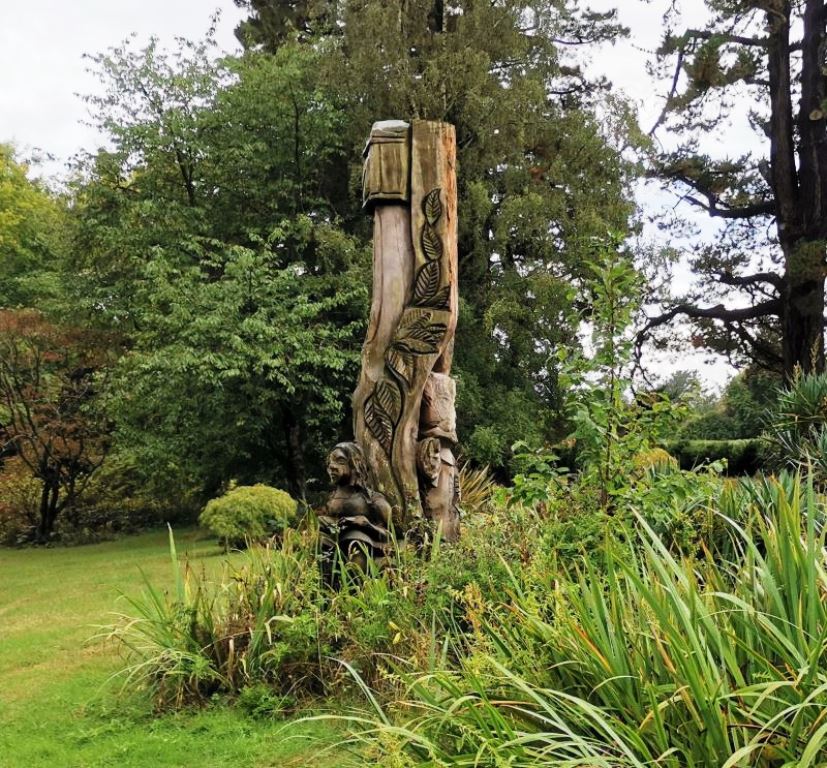
It is remarkable that Kevin has maintained the garden largely by himself for many years. He explained that the extensive yew hedging immediately behind the house is a listed feature and cannot even be trimmed without notice being given. The formality is offset by Clare Davison’s philosophy of `let it grow’, exemplified by phlomis emerging between the paving stones.
Happily, the rain soon eased away and we moved to a small terrace that overlooks the `White Sea’. The latter is a large, rectangular, yew-lined pond, alongside which Emma Henderson, dressed in white, was famously photographed for a Country Lifearticle in 1901.
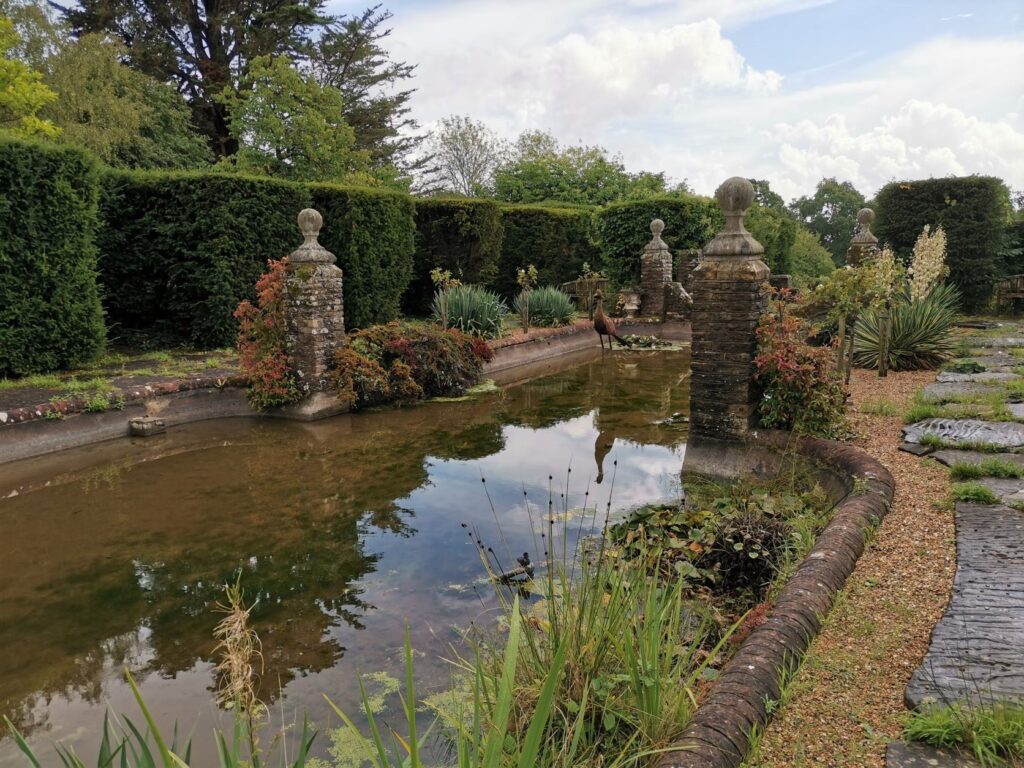
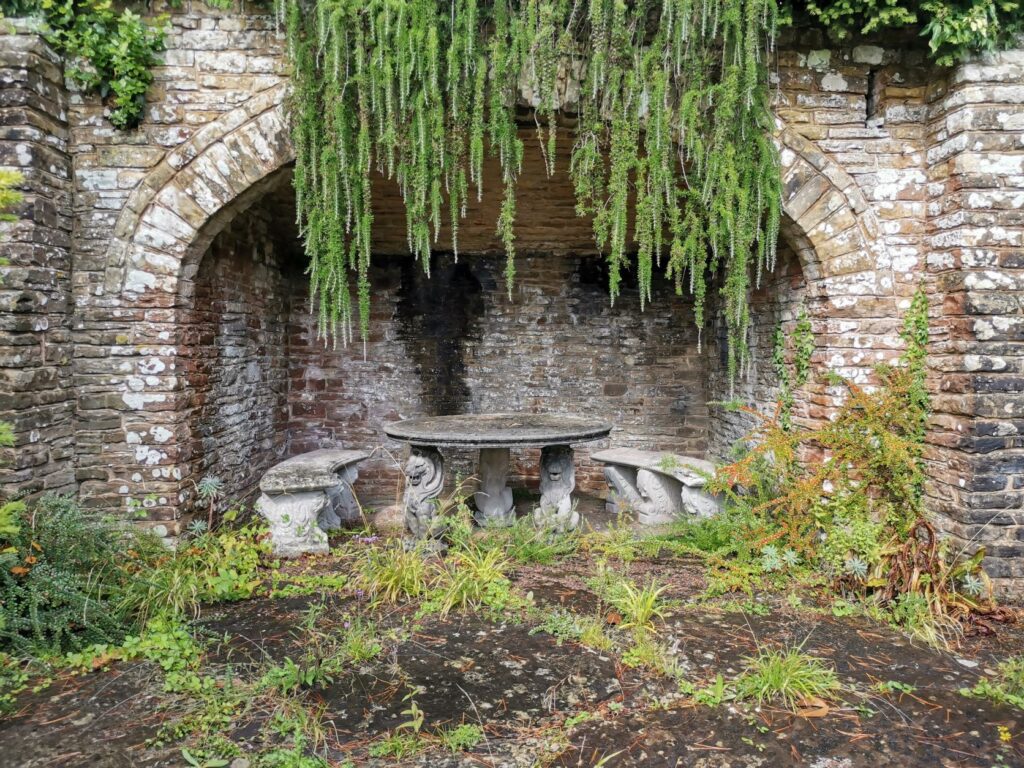
The garden has several nautically-themed features including the `Chief Cabin’, a cavity beneath the terrace at the northern end of the sea.
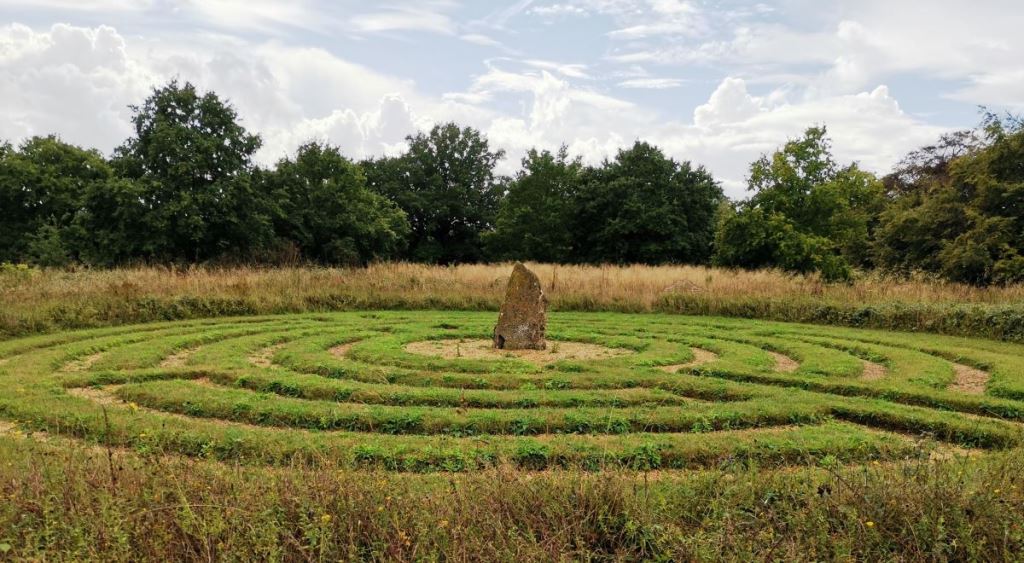
Beyond the White Sea, at the southernmost portion of the garden, we admired the turf labyrinth at the centre of which stands a Horsham stone, relocated from elsewhere in the garden. The White Sea and the labyrinth lie on the visually splendid north-south axis between the house and Chanctonbury Ring on the distant downs.
Back at the house, the second part of the visit began with tea and cake, including a specially baked and impressively decorated SGT celebration chocolate cake.
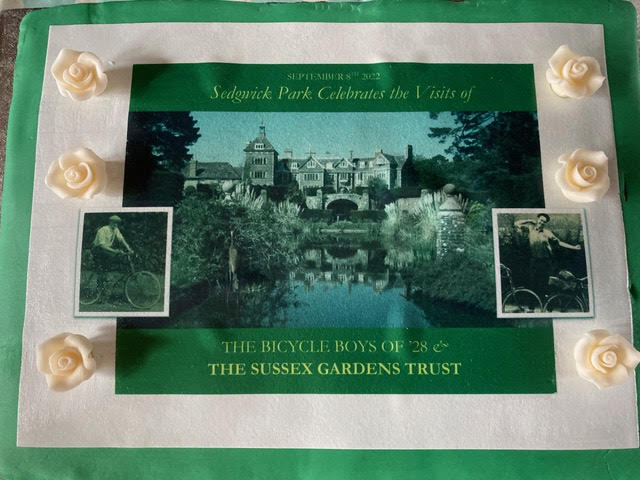
Sally Ingram gave an informative illustrated presentation about the history of the estate and the garden, followed by Clare Davison’s reminiscences of buying and restoring the house with her late husband, John. Clare, it appears, knew too little about gardening to realise the scale of what she was taking on initially, yet clearly developed a love of the garden that has enabled visitors such as ourselves to witness its beauty and historic significance.
After being presented with a thank-you from SGT – appropriately, Maggie Weir-Wilson’s book about the history of St. Leonard’s Forest, of which Sedgwick Park is a part – Clare then led a tour of the house. Worthy of an article in its own right, this featured three floors of rooms, those on the upper storeys showing Clare’s interior design skills and love for art deco. Other notable elements included an archive of articles and documents about the estate, generously laid out for us all to browse; a plaster relief on the ceiling that features Harold Peto’s initials; and a bell tower, the top floor of which affords a spectacular view above the treetops to the sweeping rise of the South Downs.
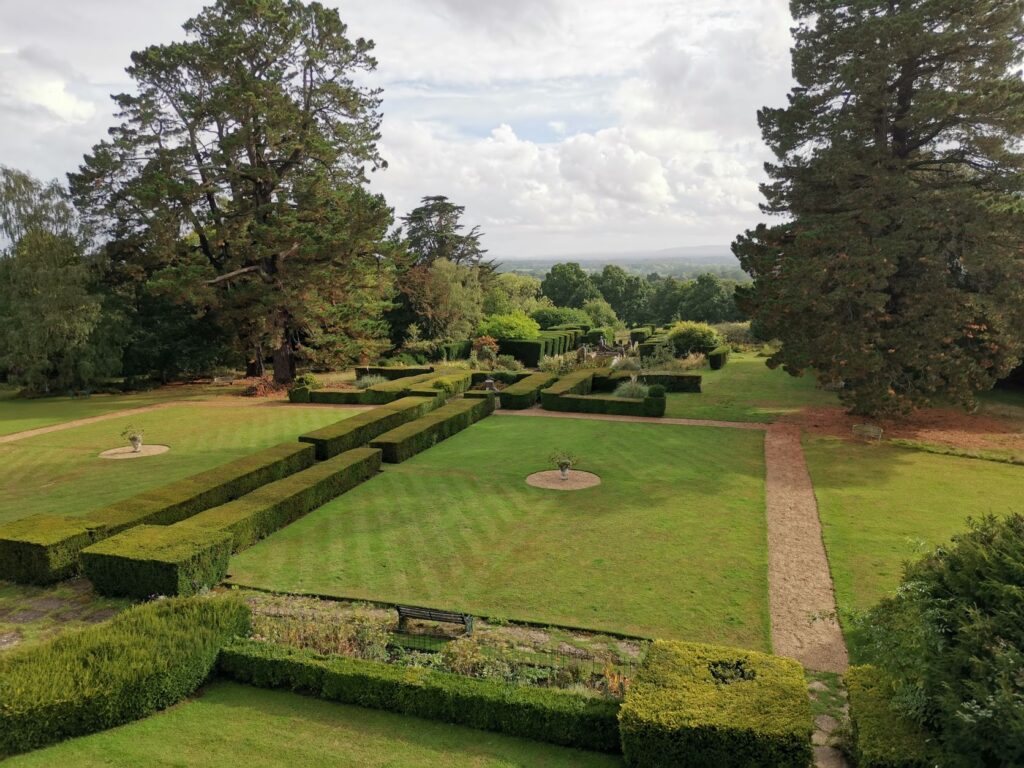
Appreciation is due to those who organised this poignant and very enjoyable visit. We departed contented with our day, unaware that the sad news that Queen Elizabeth II had passed away was soon to break.
Review by Paul Tosey. All photos © Paul Tosey, except the celebration cake, © Sally Ingram.
High Beeches Woodland & Water Garden
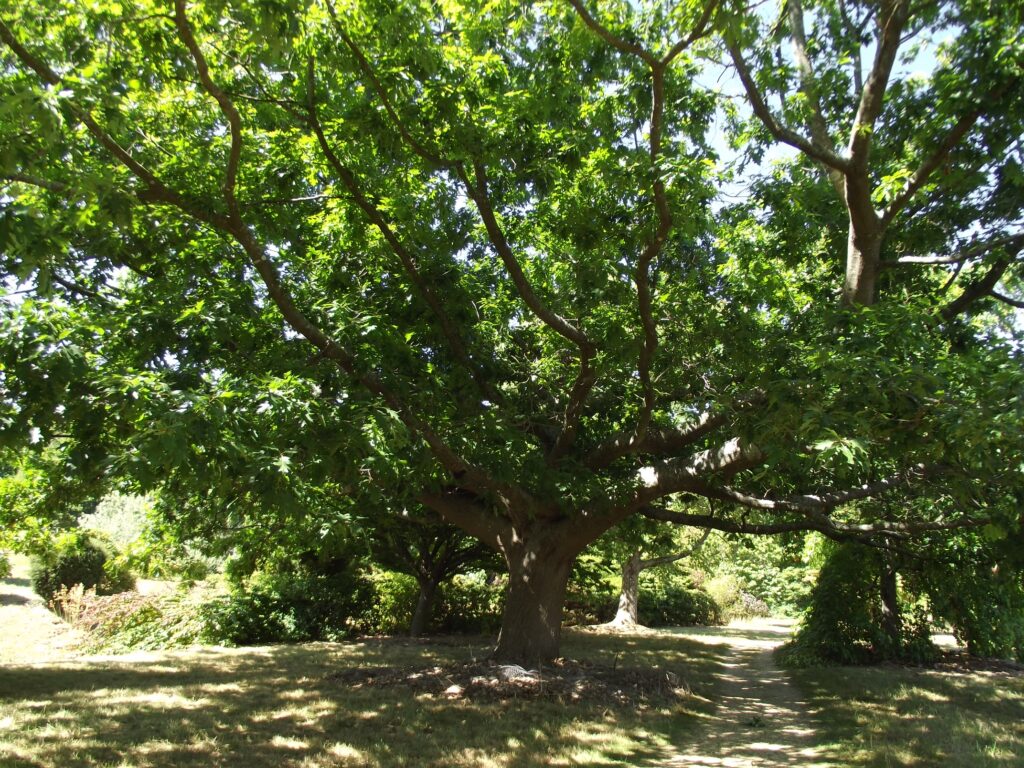
We visited this beautiful woodland garden of about twenty-five acres in August 2022, in the middle of a heatwave. It was a Wednesday afternoon, when High Beeches is closed to the public, and so we had the garden just for ourselves.
When we first arrived Sarah Bray gave us a brief introductory talk, explaining how her parents maintained the garden after their acquisition from the Loder family.
Sir Robert Loder purchased High Beeches in 1846, at a time when plant hunting expeditions around the world were bringing back new specimens, many of which Sir Robert purchased and some still survive today. His son, Wilfred, started to plant the woodland and Wilfred’s son, Giles, went on to create the garden we see today.
The terrain is uneven and steep in places with the garden routes defined with gravel paths. There were plenty of seats around the garden, some in the shade, which we were happy to take advantage of, especially as the temperature that day was in the high 30s.
Russell Yates, who has been the head gardener for twelve years, took us on a very interesting tour and explained the naturalistic style of the original planting scheme where they concentrated on species or wild forms of plants. The current-day owners are continuing to plant in the same open way. English Heritage have described the garden as ‘Outstanding Historically’ and have also listed it as Grade II*: ‘an outstanding example of an early 20th century woodland garden’. In places it is possible to see that the oaks had originally been planted in rows, I understand for ships’ timber.
There are many rare, historic and beautiful plants that thrive, too numerous to mention, with more than 200 species of wildflowers. The wildflower meadows are cut back at different times of the year to encourage the seeding of a changing swathe of colour for pollinators.
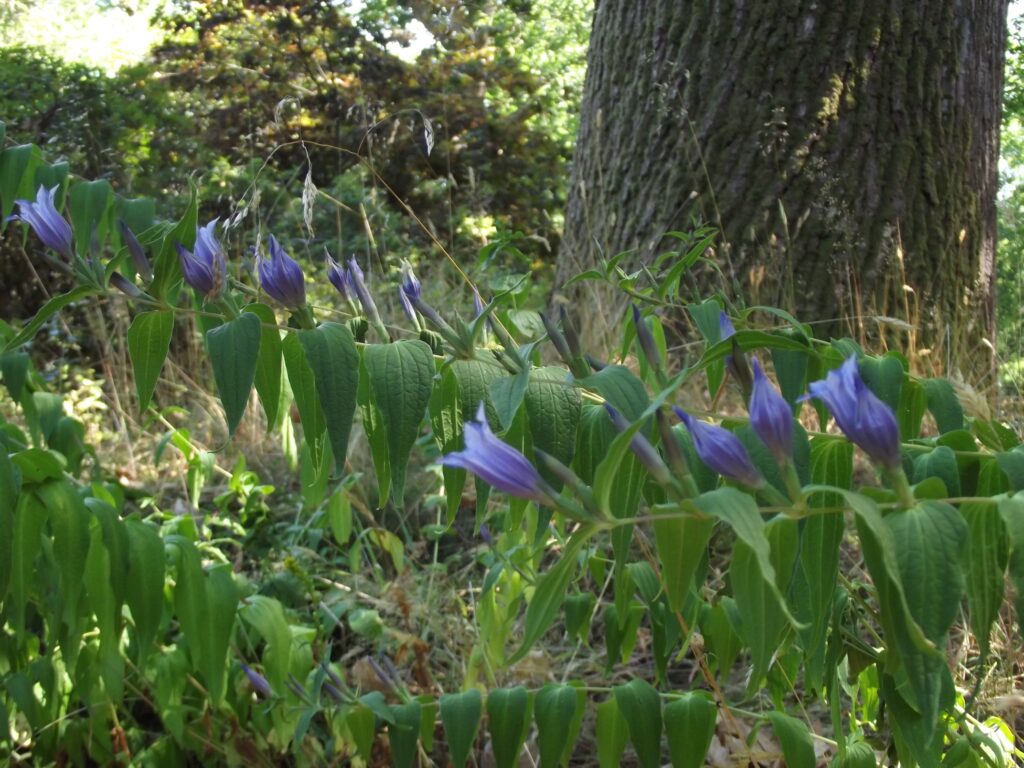
This is the only site in the UK where the willow gentian (Gentiana asclepiadia) has naturalized. The garden holds the national collection of Stewartia, which includes a Champion Tree. This is a Tea tree (Melaleuca alternifolia) with single white Camelia-like flowers.
At the far eastern side there is a nursery where cuttings are cultivated, with many from High Beeches, and some from elsewhere to ensure their continued survival. Plants and information are shared with other gardens, including the nearby Leonardslee and Wakehurst.
The ponds that run through the garden were dug after the Second World War, and today they are sometimes used for irrigation via a bucket! The ponds are linked by deep valleys called ghylls. At Centre Pond we admired the magnificent Gunnera manicata and surrounding planting.
This is a garden to visit at different times of the year to appreciate not only the many Champion Trees, but all the different colours on display. For instance, the rhododendrons, magnolias and azaleas, the many rare and unusual wild flowers, the beautiful spring blooms of bluebells, primroses and lily of the valley and of course the spectacular colours of autumn, to mention but a few.
We finished our afternoon with a much-needed cup of tea and a beautiful piece of cake and thanked Sarah and Jeremy Bray for sharing their wonderful garden with us all.
Report by Ian and Barbara Voller
Photos © Ian Voller
Luctons & the Priest House
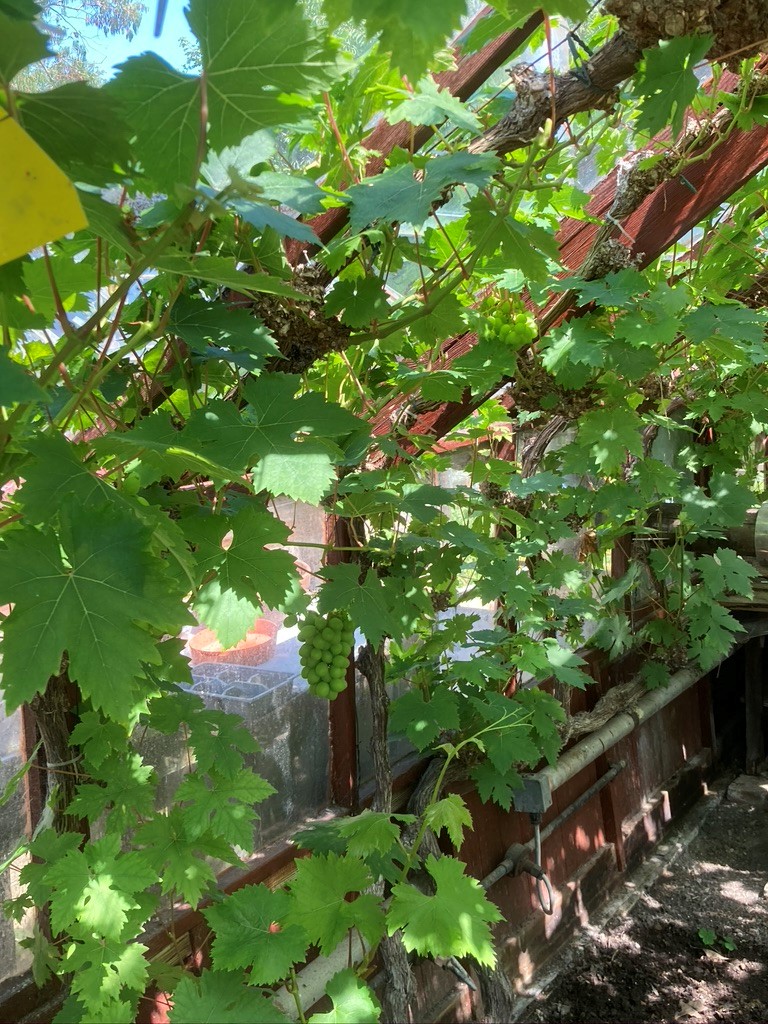
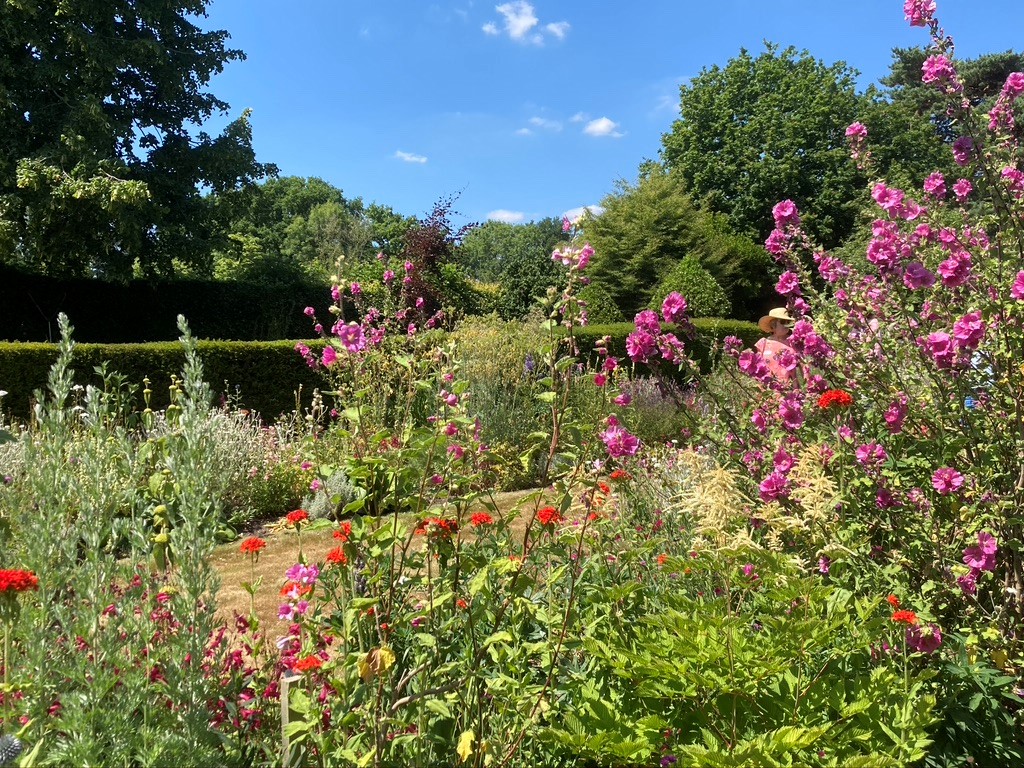
When Drs Ingrid and Hans Sethi started their garden at Luctons thirty-eight years ago they took inspiration from Gertrude Jekyll and the practice of ‘beg, borrow and steal’ to fill the garden with plants. It is a garden for all seasons: in winter there is the aroma of Daphne, in early spring the orchard is filled with fritillaries and then over 6,000 orchids appear, from a mere six planted by Hans all those years ago. The highlight of mid-summer are the long herbaceous borders filled with perennials in a bright profusion of colours and textures: salvias, lychnis, achillea, and mallow keep company and seed themselves freely. These double borders are unusual in not being against a wall, but planted so that the visitor can walk around and see the plants from all perspectives. On our delightful tour Hans showed us the orchard with old apple trees, underplanted with spring bulbs, the meadow of wild flowers, vegetable and herb gardens, and three greenhouses. Hans works in the garden every day and one of his daily tasks is pruning the grape vine.
Just across the road from Luctons and behind a clipped yew hedge with topiary peacocks is The Priest House, built for Lewes Priory in 1340 and once the home of Thomas Cromwell, then owned by Elizabeth I, before it became a family home. In 1908 John Godwin King restored the house and opened it to the public. The curator, Antony Smith, who lives in one third of the building, explained that the house was meant to grow out of the garden, which is planted with the herbs of medieval times, for medicine and for magic. Antony gave us a fascinating talk on how many of these plants were once believed to have special powers, for curing ailments and disease and for creating spells. Fern seed, for example, collected on St John’s Eve will make you invisible, because no-one has ever seen fern seeds, and so keeping some in your pocket will grant you this sense of mystery. A good thrashing with stinging nettles will help to cure arthritic joints, and meadow sweet can reduce fever. While there is little evidence of the benefits of some of these treatments, scientific research continues to develop around medicinal folk lore: lawn daisy, once thought to restrict growth, is now investigated as a possible treatment for restricting cancer cells. The garden contains over 170 medicinal plants and although we may no longer need spells and sorcery it is both rich in history and a delight for the senses.
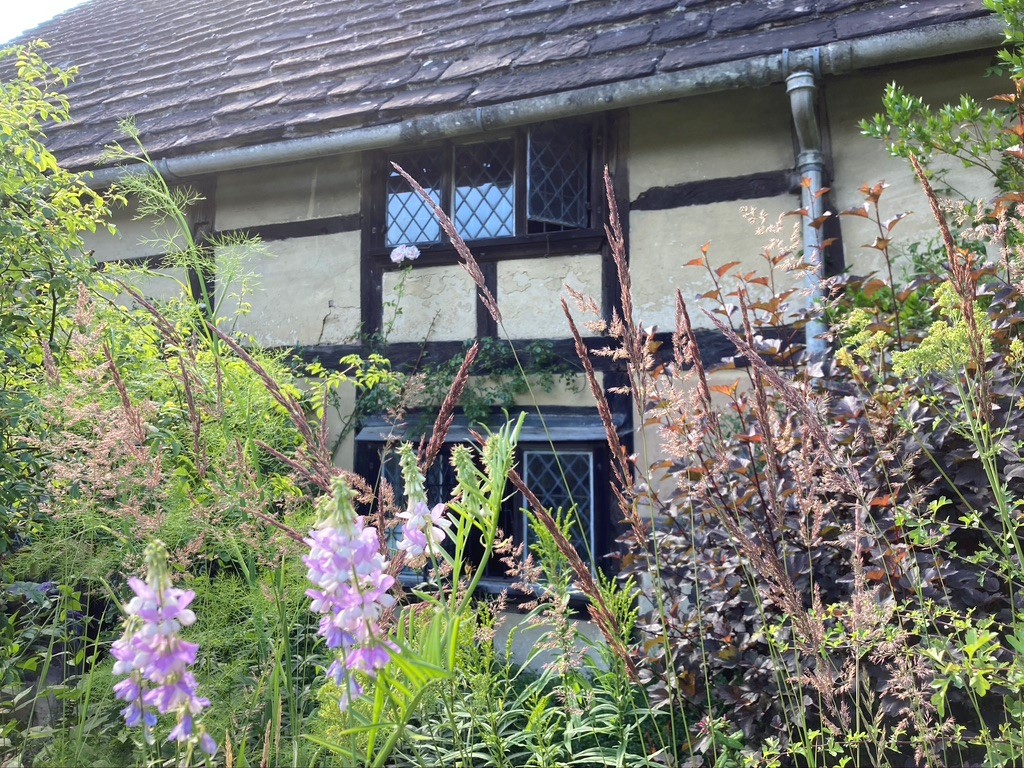
Report and images by Sally Ingram.
Twyford House
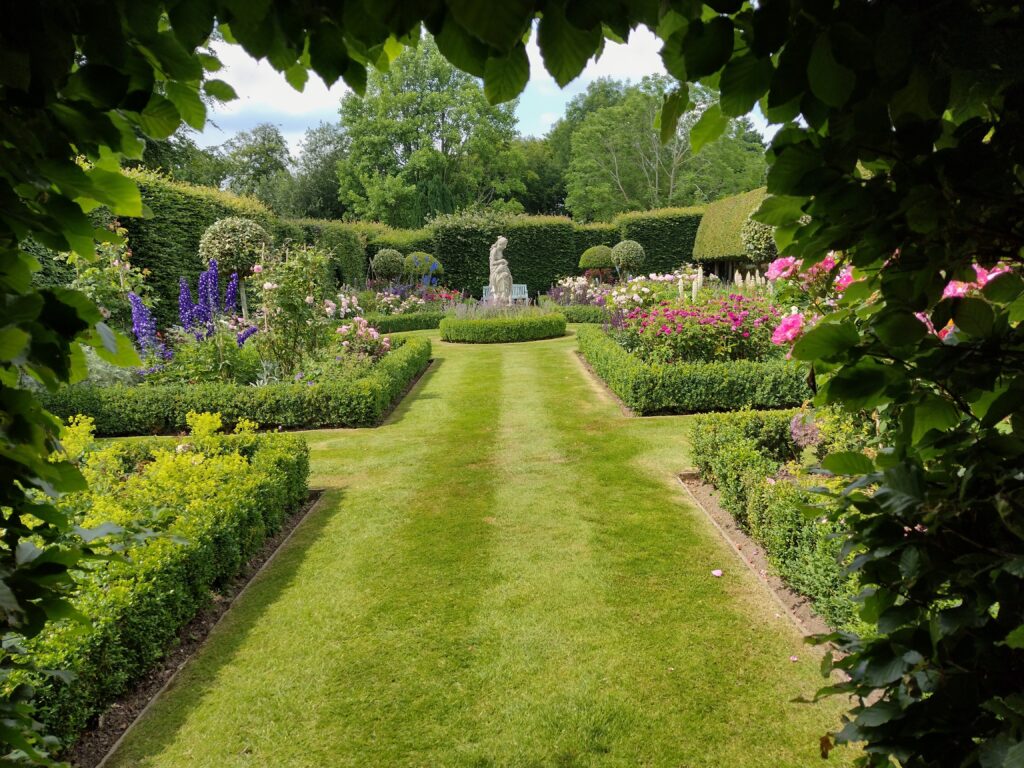
When Clive and Jenny Whitmore started their garden at Twyford House they were presented with an enclosed area with any views blocked by trees on their boundary. They took advice to remove some trees and open up the view to the landscape beyond, which has given the site a peaceful and settled atmosphere, as if it has always been so. Following advice on how to deal with the slope from house to lower boundary the ha-ha has produced an inspired solution: a series of gently sloping terraces peppered with formal clipped box mounds. Planting around the perimeter of this area is confined to white flowers, which adds to the feeling of serenity.
Hidden from view by a series of mature hedges were a surprising number of smaller enclosed spaces. Imagine the surprise after the restraint of the formal slopes to be confronted with a vibrant planting scheme of reds and purples. There was a profusion of roses throughout the garden, used in various ways: climbing in gay abandon high up, trained carefully along lower fences, planted en masse in formal beds and adorning a hidden pergola. Around every corner there seemed to be an unexpected delight.
This truly was a lovely garden, and we felt privileged to be welcomed by our generous hosts.
Report Penny Vasey
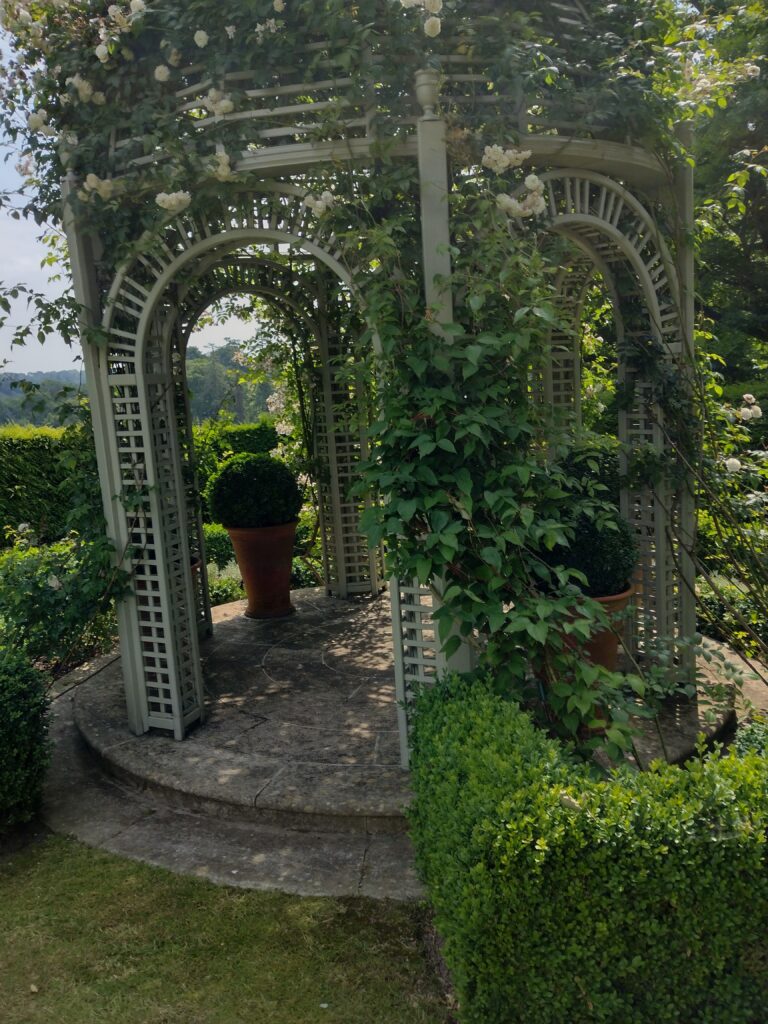
Twyford House garden. Photos by Sue Stockwell. June 2022.
Highdown
Highdown Gardens on the chalk escarpment of the South Downs is a fine example of a garden where chalk-loving, or at least chalk-tolerant plants take centre stage.
The garden was created in 1909 by Sir Frederick and Lady Sybil Stern. Stern hired plant collectors to search the world for environments that had chalk-loving flora. In association with other wealthy garden owners, he sent plant hunters across the world to places such as China, Japan and India to gather specimens, seeds and cuttings, many of which continue to inhabit the garden. In 1968 the gardens passed into the ownership of Worthing Council and despite pressure on budgets, they have maintained the gardens as a free amenity. In 1989 Highdown was recognised as home to The National Plant Collection of the plant collection of Sir Frederick Stern.
With a mixture of rock gardens, herbaceous, mixed and shrub borders and many specimen trees, the visit by SGT on 18 May was a delight. We were lucky enough to be taken around the garden by Alex New, the Heritage Plant Officer at Highdown. He gave us an amusing, spell-binding tour, and showed us fine examples of Stern’s original planting and vision. Alex explained the challenges of working in a garden with such historical links and making decisions about what should be permanently protected and which areas of the garden would need a radical overhaul.
Alex’s position is presently supported by a National Lottery Heritage Fund, which in addition to his contract has contributed funding to make the gardens more accessible. A new Visitors’ Centre has been built, and wheel-chair accessible pathways lead to a new sensory garden. One of the existing greenhouses has been restored and a new greenhouse built to help conserve the vulnerable plants of Highdown.
Report by John Dorkings.
Borde Hill Gardens
We arrived on a lovely sunny day. Instructions were to meet at the marquee just around the corner from the shop – but when we got there it was closed and looked rather devoid of chairs and tables – what was going on? The answer came very quickly – Andrewjohn and Eleni Stephenson-Clarke had invited us into their house instead for the talks – what a treat! We sat down at tables in the Trophy Room, surrounded by all sorts of family memorabilia. This really set the scene for Andrewjohn’s illustrated talk about the history of Borde Hill and his family involvement, together with information about their many champion trees. This was followed by an exciting preview of the archive material that Julia Foster and others had been discovering, preserving and cataloguing. There is nothing quite like handling a letter from Frank Kingdom Ward to Colonel Stephenson Robert Clark from the 1920s – even if it was a photocopy. After recovering from that experience with a cup of tea and biscuit, we went outside and looked for some of those champion trees or just marvelled in the Italian Garden showing off in the sun. Our hosts had done us proud.
To find out more about what the archives tell us see Vanessa Berridge’s new book Borde Hill: A Plant Hunter’s Paradise published April 2022.
Caroline Holmes – Where the Wildness Pleases
Caroline gave us a series of very engaging zoom talks about gardens of the High Weald – two before Christmas and two early in this year. SGT was pleased to host these events in conjunction with The Gardens Trust – and they attracted large audiences. We were treated to a range of stories behind many well-loved gardens in Sussex including Ashdown Park, High Beeches, The Priest House, Merriments, Standen, Hever and lots more. She covered follies, arts & crafts influences, plant collectors, woodland gardens and much more – giving us new insights into gardens we thought we knew. If that whets your appetite find out more in her book Where the Wildness Pleases: The English Garden Celebrated.
Unforgettable Gardens series
SGT arranged and hosted these four talks in conjunction with The Gardens Trust. In the first talk, Gwendolyn Van Paasschen gave us an entertaining and informative tour of Denmans Gardens and told us all about the restoration work currently happening there – definitely a place to visit to see the progress.
See www.denmans.org for more details.
The double act of Alex New ( Plant Heritage Officer ) and Hamish MacGillivray (New visitors Centre curator) entertained us with stories of the garden’s history, the links with early twentieth century plant hunters and the amazing plant collection held there – and this is a Council owned and run garden!
See highdowngardens.co.uk for more details.
The third talk, given by Andrewjohn Stephenson Clarke from Borde Hill and his newly appointed Head of Horticulture, was another fascinating glimpse into the world of garden owners who sponsored a series of plant hunters and ended up with amazing plant collections. Do visit the garden to see it for yourself link
In the final talk, Sally Ingram took us on a whistle stop tour of six gardens in Sussex where Gertrude Jekyll had prepared designs, including Legh Manor in Ansty – a neglected Jekyll garden which was lost but is now being regenerated by its new owners. You can read all about this and much more in the SGT Publication that came out of this research project.