
Many artists have been attracted to the landscape and the coast of Sussex, and if not setting up home, often returned to a place of inspiration. John Constable, visiting Brighton in 1824, and despite at first remarking that Brighton was ‘only Piccadilly by the sea-side’, created a large painting of the chain pier and fishing boats, shown at the Royal Academy exhibition of 1827. J. M. W. Turner celebrated the parkland and the interior of the house at Petworth in a series of paintings completed between 1828 and 1837 while staying as a guest of the third Earl of Egremont. Two scenes of Petworth Park can be seen in the Carved Room at Petworth, in the original place devised for them by the third Earl and Turner.
The artists Vanessa Bell and Duncan Grant moved to Charleston Farmhouse in 1916 and the home became a retreat in the countryside for writers, poets and painters, including Maynard Keynes, T. S. Eliot and Roger Fry. Vanessa described the house as ‘absolutely perfect’ and while she and Duncan transformed the rooms with paintings and stencilled the walls in distinctive colours, the walled garden was laid out by Roger Fry, with a pattern of gravel paths surrounding a lawn and pool. A small orchard had an abundance of fruit trees and the walled garden was used mainly for growing vegetables to provide food for the family.

Quentin Bell, Vanessa’s son, created a number of sculptural features which can still be seen in the garden, while art school plaster cast heads, found by Duncan Grant, look down from the flint walls.
The original glazed tiles for the pond were made by Vanessa Bell, and then copied and replaced by her son, Quentin, during the 1980s. In 2008 SGT provided financial help from their Small Grants Fund to restore this formal pond which had been leaking for some time. Over the years the tiles decorated by Quentin Bell had become damaged by frost, and facsimiles were made by the potter Vicki Walton, who had worked alongside Quentin Bell as his pottery assistant.

Virginia Woolf, and her husband Leonard Woolf, bought Monk’s House in Rodmell for £700 at an auction, and moved to what would be their final home in September 1919. Her sister Vanessa was a six-mile walk across the fields at Charleston, and despite the frequent cold, or rain, or floods, Rodmell was safe, as she wrote in her diary in April 1929, ‘from voices and talk’. With her writing room at the end of the garden the house was ‘a perfect triumph, I consider’.
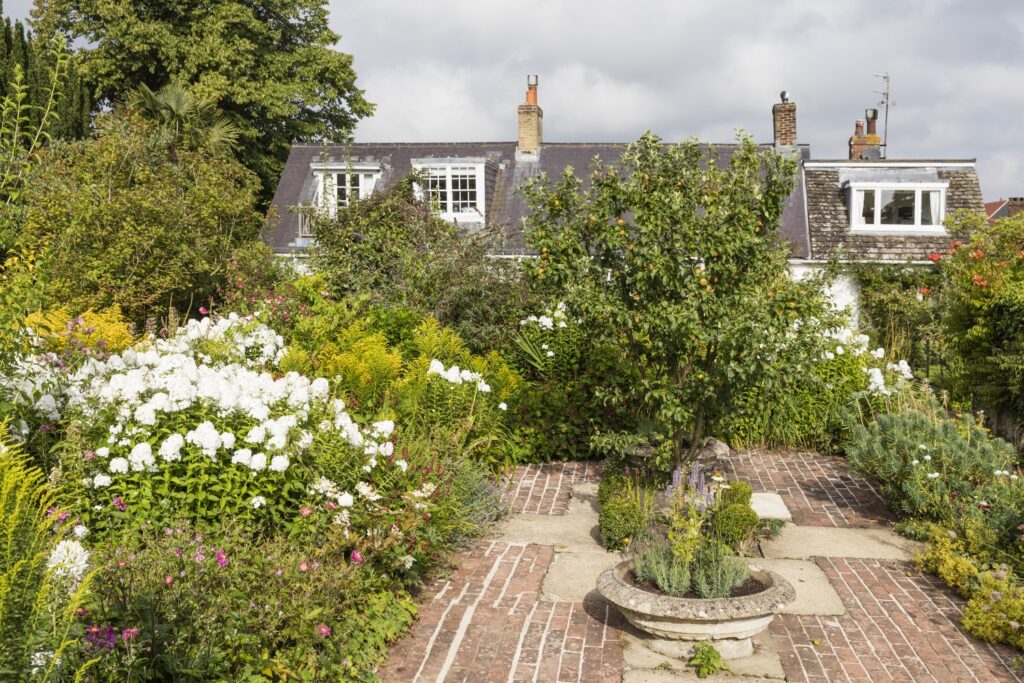
The garden at Monk’s House was Leonard’s achievement, where he created a terrace and divided different areas with the old flint walls remaining from earlier piggeries, while Virginia was happier buying pieces of furniture from shops in Lewes, and painting the large sitting room sea-green. The garden, she wrote, had ‘an infinity of fruit bearing trees … unexpected flowers sprouted among cabbages’ and on spring evenings she weeded with Leonard, among the rows of peas, potatoes and raspberry bushes.
The artist Eric Ravilious, although born in Eastbourne, made his home in Essex, but frequently returned to Sussex where he was drawn to the details of everyday life: the machinery of the chalk workings, cement works, abandoned wagons, a shepherd’s cottage. When staying at ‘Furlongs’, a cottage belonging to the artist Peggy Angus, he discovered the greenhouses in the walled garden at Firle Place, which became studies for his paintings, including The Greenhouse: Cyclamen and Tomatoes (1935) and Geranium and Carnations (1938).
Rudyard Kipling began writing the stories for The Jungle Book while living at The Elms in Rottingdean for a brief period between 1897 and 1902. Part of the original walled garden has been renamed Kipling Gardens and is open to the public.
When his young daughter died in 1899, Kipling moved to Bateman’s in Burwash for more seclusion, and lived there with his family until his death in 1936. He laid out the gardens to his own design and some of his original drawings for the garden survive. As well as a lily pond he designed the Mulberry Garden with perennial and annual flowers. In the 1970s this garden was redesigned by Graham Stuart Thomas but has since been recreated to a design closer to Kipling’s original plans.

At Bateman’s Kipling set about making an orchard, planting yew hedges and buying the surrounding farmland to create a 12-acre garden in the High Weald, but the gardens of these artists and writers are often humble rather than flamboyant: a fruit tree, a row of peas, a few cabbages. Even the mosaics in the garden at Charleston were created from broken pieces of everyday china plates. The artist Ivon Hitchens created his panoramic vistas of the Sussex landscape in the 1940s, after purchasing a piece of land at Lavington Common, near Midhurst. He began living in a caravan, with no electricity or running water, until a house was built, where together with his wife Mollie, he filled a courtyard garden with poppies, sunflowers and dahlias. He painted the garden and the surrounding woods in the open air, in all weathers, for the rest of his life.
It is the garden that for these writers and artists offers a retreat, an escape from a busier and often harsher world. Charleston became a refuge for the unconventional collection of friends during the years of the first world war, where they could talk and paint freely. Rodmell provided Virginia Woolf with intervals of calm, during which she completed Mrs Dalloway and began Orlando in between the ‘battlefield of emotions’ as she once described her life. For Kipling, the move to Bateman’s meant an escape from the ever-watchful eyes of his followers. Ivon Hitchens first came to Lavington Common when the bombing raids started in London, to a house in the woodland, that apparently could not be seen from a distance of ten yards. These homes and gardens of the artists and writers are set apart, away from unwanted intrusion, yet places full of imagination where new and surprising ideas could be brought to life.
Banner Photograph: Duncan Grant’s Studio ©Charleston Farmhouse/James Bellorini