
Parks and gardens are key components of the historic environment, and take many forms, including public parks, the grounds of historic houses and sites, cemeteries and town squares: what they have in common is that they are all designed landscapes.
Some are recognised by national designation, listed on the Register of Parks and Gardens of Special Historic Interest in England by Historic England; others are identified as significant by local planning authorities. As with other projects, changes requiring planning permission at such sites must be approved by Local Planning Authorities before work is undertaken.
The role of Sussex Gardens Trust (SGT) and The Gardens Trust
Where a planning application may affect a listed Park or Garden, the Local Planning Authority is required to consult The Gardens Trust, which in turn informs local County Gardens Trusts such as SGT. Where there are issues of major concern, The Gardens Trust may comment directly, but in most instances volunteers from SGT review applications in Sussex and contribute constructive and informative comments to the Local Planning Authority.
A log of cases considered by SGT in recent years may be accessed via the menu (Planning Case Work Log).
You can find more details about the process from this leaflet published by The Gardens Trust.
Case Study – Roman Bath in Summerfields Estate, Hastings
Over the past few years, SGT researchers have undertaken detailed research into less well-known parks and gardens in Hastings, including Linton Gardens, Wellington Square, White Rock Gardens, and Summerfields Estate (previously known as Bohemia Estate). Based on this research, we were delighted that Hasting Borough Council (HBC) added all of them to their Local List of Heritage Assets. HBC were also very appreciative of our work and wrote to say “The panel considered the heritage significance of this assets to be high and the panel members were united in recommending the asset for listing. I would like to thank SGT for the hard work in this process”.
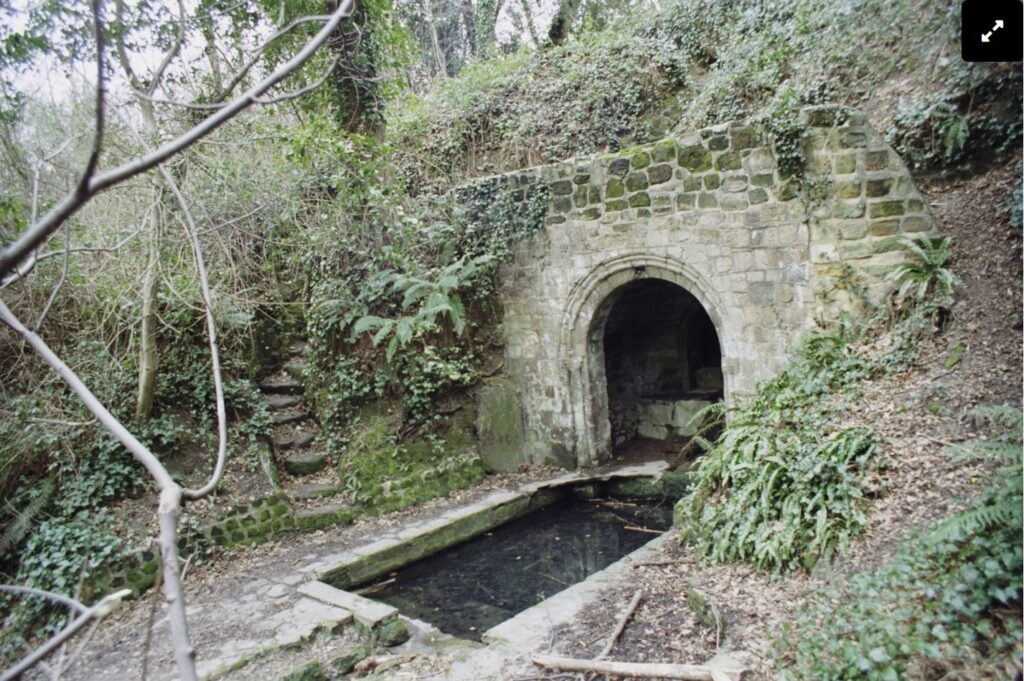
The Summerfields Estate includes an unusual building, a replica of a ‘Roman’ Bath-house (listed at Grade II).
It comprises a sandstone rubble retaining wall about 4m (12’) in height with steps either side leading to a viewing platform and a Romanesque arch with colonnettes; behind the arch is a semi-circular grotto with small waterfall cascading into a rectangular pond, also of sandstone, with four cement steps.
The benefit of including such sites on the Local List is to help influence planning decisions in a way that conserves and enhances the asset, in line with the requirements of the National Planning Policy Framework. However, it does not always work as it should. The structure was fenced off for health and safely purposes, but over recent years due to lack of maintenance by Hastings Borough Council the condition of the site and in particular the fencing fell into disrepair, partly due to vandalism. Worse still, without seeking planning permission, in 2021 Hastings Borough Council installed utilitarian, brightly coloured galvanised gates and grid which are entirely unsympathetic to the sandstone ‘Roman’ bath-house and its setting.
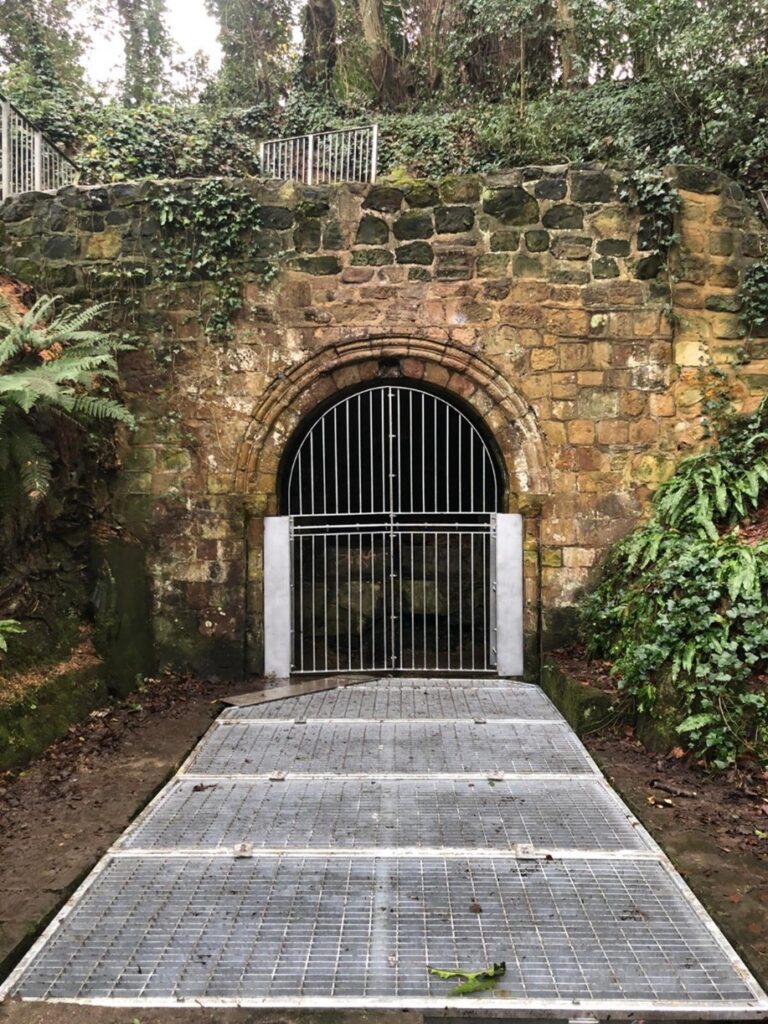
In May 2021 HBC submitted a retrospective planning application seeking permission to keep these galvanised structures. HBC is acting as judge and jury on this and in July 2021 SGT submitted a robust objection, although we have offered to help devise a better solution to meet both heritage and health and safety concerns. Historic England later endorsed our comments adding that “the introduced metal gates and grill are entirely unsympathetic to the appearance of the sandstone ‘Roman’ bath-house and its setting”.