
‘Women . . . were the great garden-lovers, and indeed they inhabited gardens, while most men, until old age, only visited them’.
Dorothy Richardson (1873-1957) wrote about gardens, about men and women, and about the direction of society and became known as a modernist novelist. In 1918 the critic and novelist, May Sinclair, used the term ‘stream of consciousness’ when reviewing Richardson’s first novel, Pointed Roofs, published in 1915. This was the first time the phrase had been used to describe fictional technique, so Richardson (who hated the term) earned a place in literary history.
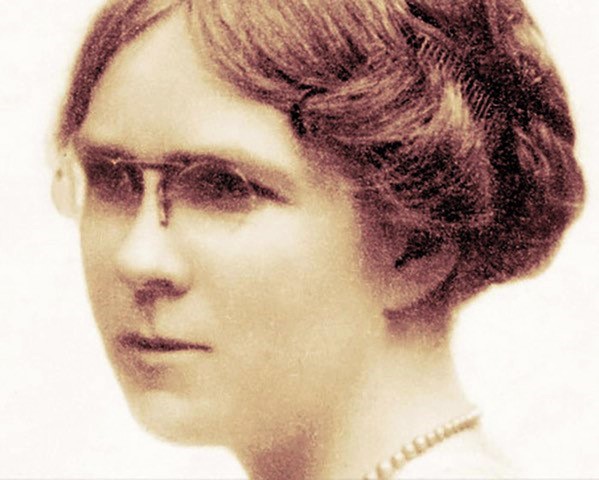
Pointed Roofs was the earliest of thirteen semi-autobiographical novels in a sequence called Pilgrimage. Although some of her works are still in print and she has a devoted following, her popularity has waned; the definitive biography is entitled The Genius They Forgot, written by John Rosenberg in 1973.
Her literary career began in a Sussex garden, in 1907. At the age of thirty-four, her future must have seemed grim. Some years before, her mother had committed suicide and her father had gone bankrupt. Dorothy Richardson lived in a rented attic room, supporting herself as a receptionist at a dental surgery. She was involved with London’s radical circles, where she met H G Wells; the result was a pregnancy, a miscarriage and a breakdown.
Seeking peace, she moved for a time to Windmill Hill, near Herstmonceux, on the southern edge of the Weald, with a view across the marshes to Pevensey Bay. She was a paying guest of the Penrose family, Quaker farmers who owned a property called Mount Pleasant. She found peace in the garden of Mount Pleasant and in the lives of the Quakers. She described this time of her life in her 1938 novel, Dimple Hill.
Mount Pleasant had been developed as a ‘pleasure farm’. The sales particulars from 1898 give details of the ‘carriage sweep’ and the house, and describe the property as ‘a most complete little pleasure and poultry farm’. A pleasure farm was a farm which need not produce an income, and was ideally suited to a retired city gentleman. Throughout the nineteenth century, the pleasure farm became a prominent feature in the Wealden landscape.
The house and garden are described in great detail in the novel. ‘The place was not in the least like a farm. A white five-barred gate, fastened back, a sweep encircling a bed of evergreens, grass-bordered, a square plaster house, two-storied, bleak. . .’.
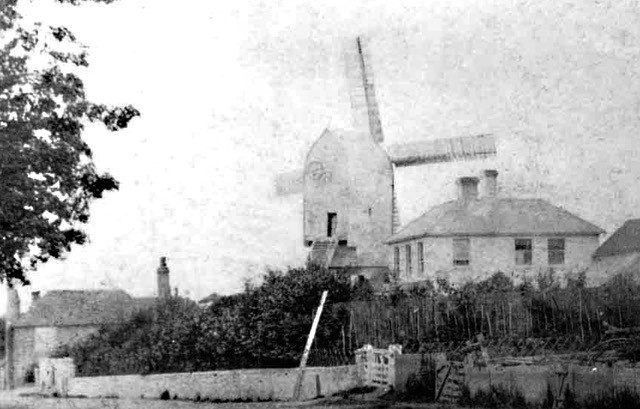
By 1907, Mount Pleasant was changing from a pleasure farm to a working farm. We see Richardson ‘settled in the decrepit deck-chair under the chestnut tree… Left alone, she listened to the swish, swish of the hedge-cutter, a busy accompaniment to the lazy, ceaseless coo-rooing of the doves, and heard it cease. A moment later, pushing a barrow of weeds, Alfred Roscorla came through the gap in the hedge, turning the barrow as if to cross the lawn immediately in front of her’.
Richardson loved gardens and the novel includes a five-hundred-word description of a delphinium clump in the grounds of Mount Pleasant, a vestige of the older days. A garden was not only a place of aesthetic delight and spiritual calm, it was a place created by human effort.
‘Somewhere away down the far slope, the men were at work, part of the world-wide army ceaselessly toiling through the centuries, without whom secure, smooth-lawned enclosures would never have come into being. Why were some exempt? Why such armies to support the exempted? Why, of these few, almost none worthy of exemption?’.
Interestingly, she struggles with the idea of a garden as anything other than a place of privilege and leisure. She has an insight into domestic gardens which might come as an enlightenment:
‘The sensitive creatures by whom she was surrounded were certainly alive to the beauty of their gardens. A treasured superfluity. Like the proletarian parlour so cruelly condemned by commonsensical half-wits. A temple undesecrated by the presence of the implements of toil. Kept always swept and available. Rarely used, but always operative, a refreshing harbour for the mind’.
At Windmill Hill she began to write short semi-fictional sketches of Sussex life, and in 1914 published a history of the Quakers. After achieving recognition as a writer, Richardson often returned to Mount Pleasant.
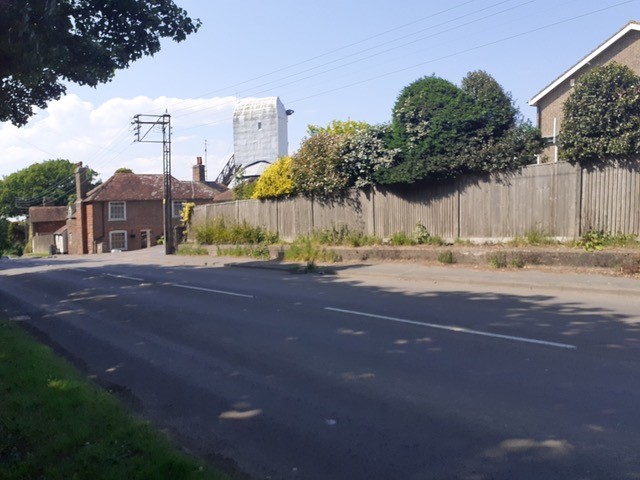
Sadly, the garden at Windmill Hill is not just lost, but obliterated. Sixty years after Dorothy Richardson first visited Mount Pleasant, the bulldozers moved in. To understand the garden there, you will need to read Dimple Hill.
Article by Alan Starr
All quotations from Dimple Hill (Dent & Sons, 1938)
Professor Scott McCracken of Keele University curates a Dorothy Richardson website which is recommended if you would like to know more. The image of Richardson is from his website.