Keukenhof Gardens
It was with an impulsive desire to see something different after lockdown that persuaded me to book up a five-day coach trip to Amsterdam to see Keukenhof Gardens and The Floriade. I got the last seat on the coach and was delighted; less delighted when they forgot to pick me up, but that’s another story. I had been to a previous Floriade, but never to the Keukenhof Gardens which are well known for their tulip plantings. I like tulips but I had assumed the gardens would be rather formal and therefore not really to my taste, but how wrong I was.
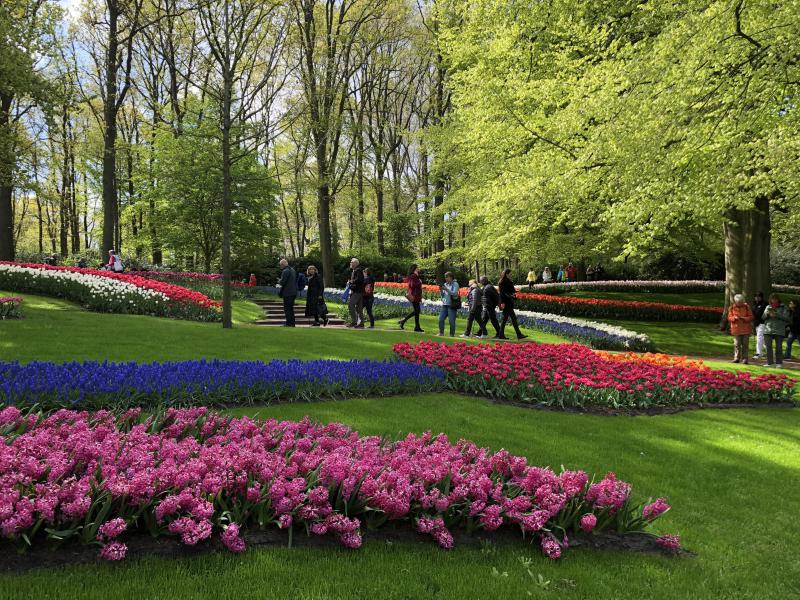
Keukenhof is just wonderful. A thirty-two hectare park filled with over seven million flowering bulbs, of at least 800 different varieties, all planted by hand in the autumn. It is open for seven weeks in the spring each year. This year it was from 24 March until 15 May, and open from 8.00 in the morning until 7.30 at night, giving everyone a nice long day to see everything. In March it is all the daffodils and crocuses, and in late April, when I went, it was all the tulips and hyacinths. The theme this year was Flower Classics, although I was none the wiser – one would have to know something more about tulips to have appreciated this.
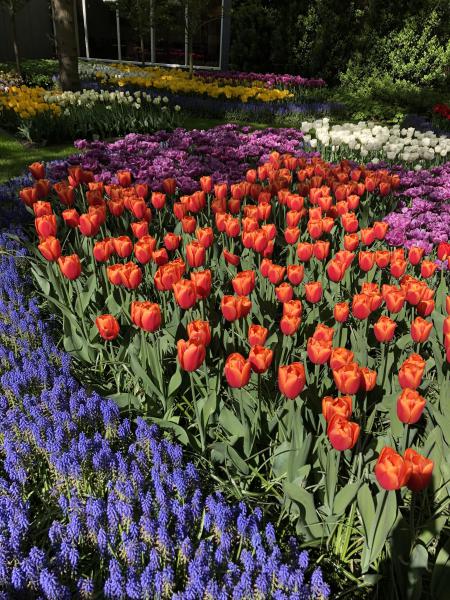
Set amongst the gardens there were six pavilions where one could learn more about tulips, their history, the development of the black tulip, seventeenth century tulip mania, and current breeding programmes. A particularly impressive pavilion was one full of orchids. This was a surprise and I could not comprehend the amount of attention and work such a huge display would need. Best of all however, was just wandering the paths, lakes and woodlands appreciating the different varieties of tulips, the colours, how they had been put together, and the underplanting. I was interested to see how tulips were even planted on grassy ridges in woodland, along with other bulbs and Californian poppies. One mixed bed showed forty different tulip varieties, planted among Camassia, Crocus, Fritillary, Narcissus and Hyacinthus. I was particularly impressed with the use of dark blue grape hyacinth (Muscari) as an edging and foil for the bright tulips, and then the use of a light blue amongst pale pink tulips.
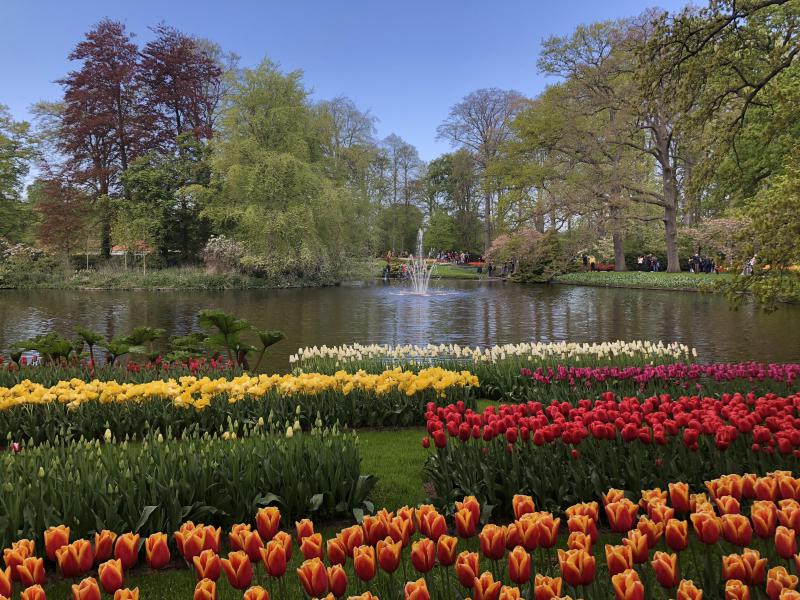
One of the pavilions had cut flower shows every week, and there were clever art installations in others. There was a lovely Dutch windmill and picnic area near one of the lakes from where visitors could go for a boat ride out to the flat fields of flowering bulbs. There were shops and cafes in all the pavilions and where you could order bulbs that had taken your fancy. I noted the names of certain varieties I liked, plus a many-headed Narcissus ‘Sunlight Sensation’ that I will look for in the autumn. It was a really inspirational visit, and I cannot believe this was the first time I had been; hopefully, it will not be the last.
The Floriade
After a rather chaotic and noisy day in Amsterdam on King’s Day, when the nation all wore something orange and were seriously determined to party in the streets and canals of the city, I had a quiet day at The Floriade. This celebration of the Netherlands horticultural industry occurs every ten years on different sites each decade. This year it is set in the green town of Almere, to the east of Amsterdam. The exhibition opened on the 14 April and will run until the 9 October 2022. The theme this year is ‘Growing Green Cities’ and it aims to showcase innovative developments in all things green and sustainable.
The site is twice the size of Keukenhof. It has a small train running around the perimeter, and a real cable car strung diagonally across the site which give a terrific bird’s-eye view of the wide canal through the middle and Utopia Island in the north. Although it is difficult to grasp at first, there are five sections to see: Urban District, Utopia Island, Green Island, Hortus Avenue and the Eco District. Each has something different to offer depending on your interests.
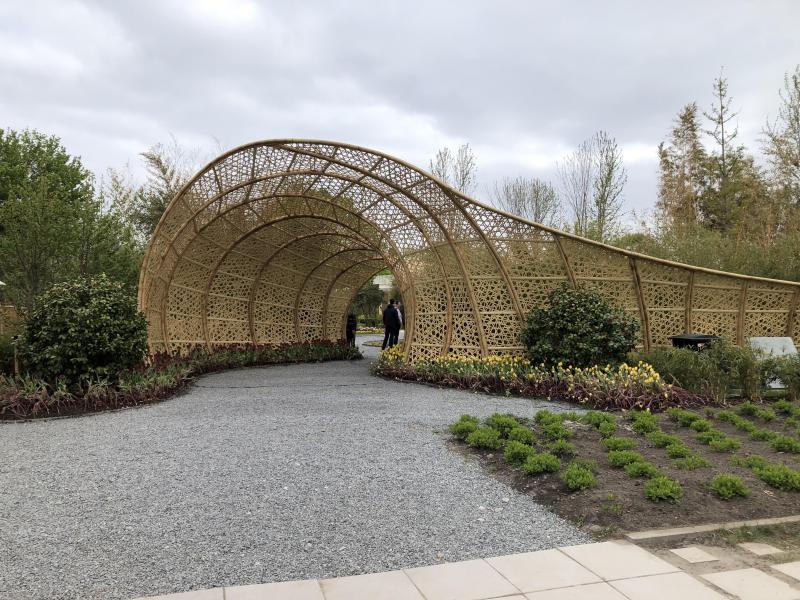
The Urban District was where the international stands were. Countries such as Germany, Italy, Bangladesh, China, United Emirates, Qatar, Thailand, Turkey, Japan and, of course, the Netherlands were all represented by gardens and information. The China garden had a lovely bamboo garden arch and furniture along with a misty pond and planting. I was particularly taken with the lemon trees on the Italian stand. The lemons were trained against fan shaped frames in pots and so the many lemons were easy to pick.
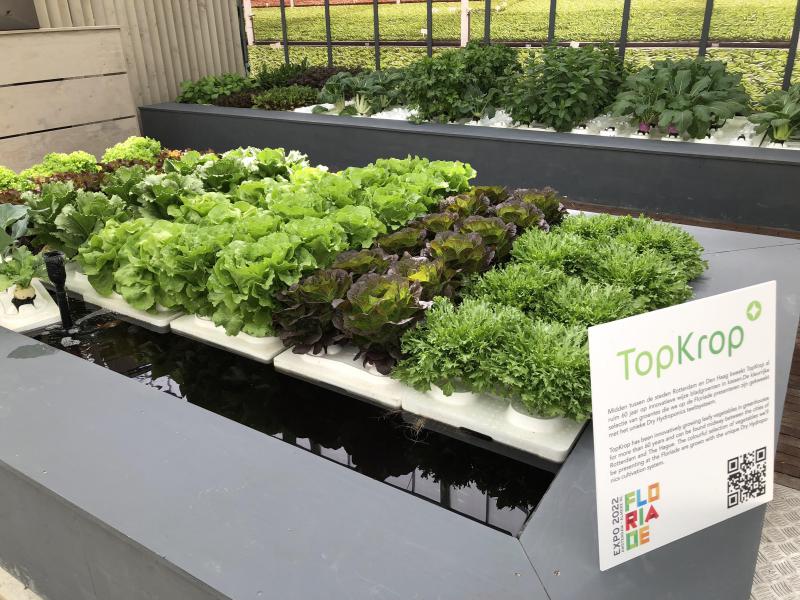
The very large greenhouse on Hortus Avenue was full of over 100 small stands explaining new and sustainable methods of growing. One that I found interesting was the ‘dry hydroponics’ by a company called TopKrop. They had examples of leafy crops looking absolutely pristine and delicious growing in nutrient water with only the roots actually touching the water. In the Green Island section there was an arboretum with trees planted alphabetically and examples of tiny sustainable houses, plus a house weirdly made out of mycorrhiza and fungi.
There was so much to see it really needed more than a day, but from what I saw I found it a hopeful and inspiring exhibition. Once it closes the site will form a new district of Almere which should be a great place to live: sustainable, green and beautiful.
Article by Maggie Weir-Wilson
All photos © Maggie Weir-Wilson. www.maggieweirwilson.co.uk