
Lisbon has many justly famous, and very busy, tourist attractions; any guidebook will highlight the Castel de São Jorge, the Elevador de Santa Justa, the no.28 tram and many others. On the evidence of a recent visit, however, one site is conspicuous by its absence from any `Top 20’ list.
You can probably name some of the largest glasshouses in the world, for example the Eden Project’s biodome and Singapore’s Flower Dome. Yet it is quite likely that you have never heard of the largest shade house in the world – that is, with no glass or equivalent and no heating. This appears to be Estufa Fria, which translates as `cold greenhouse’. The official Lisbon tourism website does describe it, though not very prominently given that it is probably the world’s largest example of its kind, as `one of the most important green spaces in Lisbon, considered an authentic living museum, with its small lakes and waterfalls, statuary, and hundreds of species of plants’.
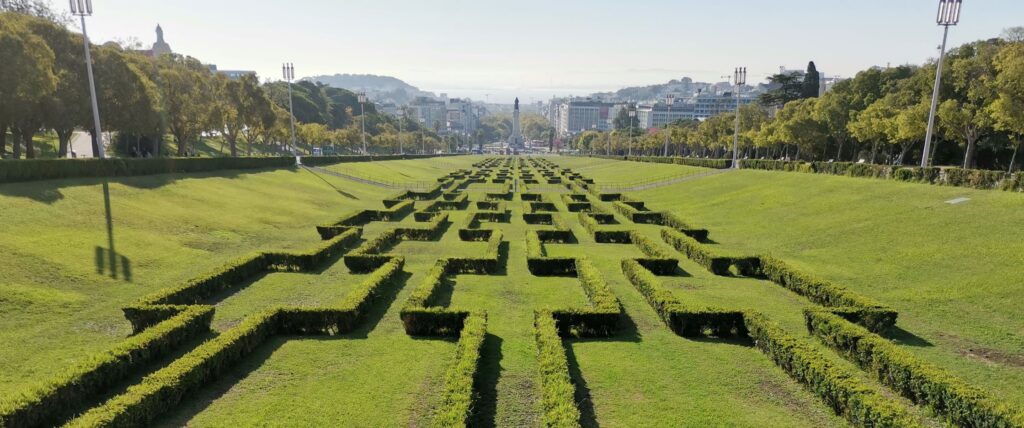
In the early October sunshine, my wife and I took a morning bus ride from our hotel to a terrace at the northern end of Lisbon’s Parque Eduardo VII (the same King Edward VII after whom the sanatorium in Easebourne, Sussex, which featured a Jekyll garden, is named). On its eastern side is the Carlos Lopes Pavilion, built for the 1922 World Expo in Brazil then relocated to Lisbon in 1932. The terrace offers a wonderful view across clipped box hedging down to the city and the river Tagus.
Our guidebook mentioned a hothouse on the park’s western side so we decided to take a brief detour before continuing to the city centre. Initially there appeared to be nothing there beyond the railings that edged the path, but a view emerged of a curious surface stretching out into the distance. Vaguely resembling a massive roller-skate rink, this turned out to be the roof of the Estufa Fria, which is sunken into a former basalt quarry.
Continuing down to our right, we found a lake and the main entrance where, being over 65, I had to pay all of €1.55.
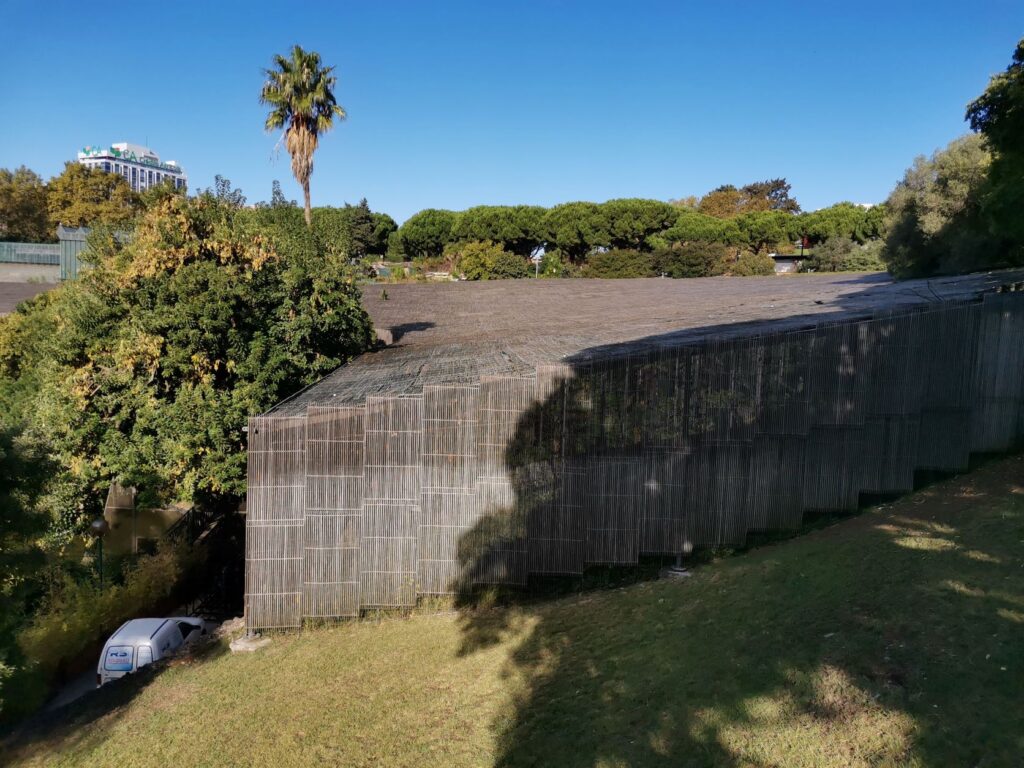
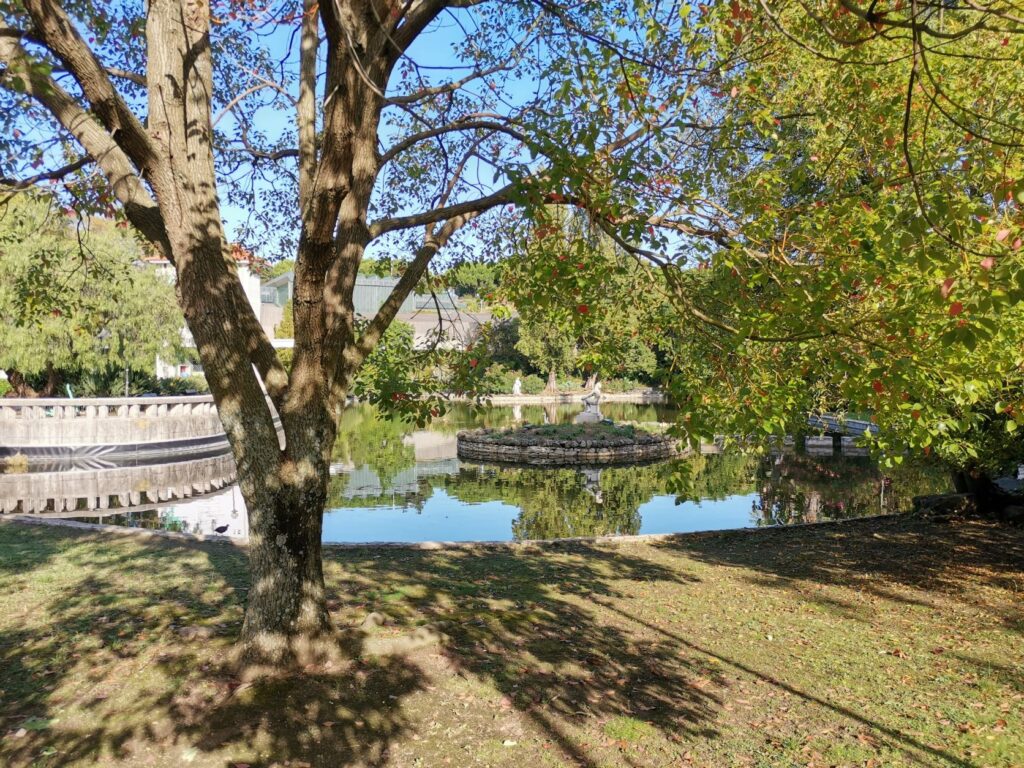
Once inside, a stunning, magical, landscape opened up beneath the slatted roof.
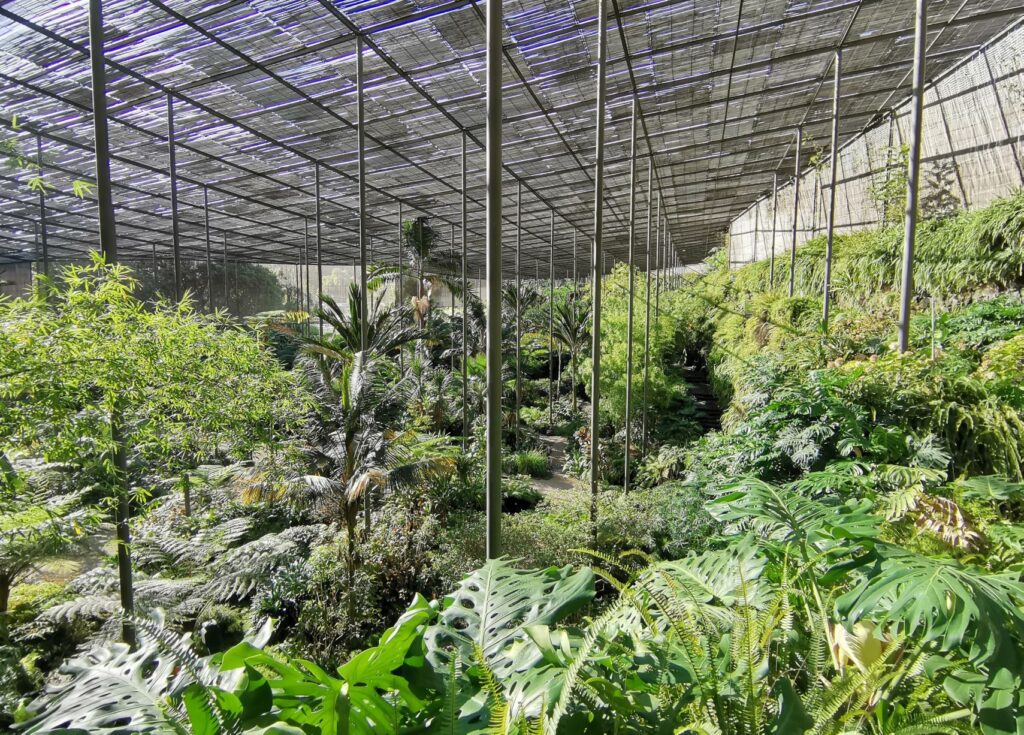
The planting is a mass of tree ferns, rhododendrons, camellias, green bananas, colocasias, strelitzias and more. There are pools, statuary and arches intertwined with winding gravel paths and stone steps that enable you to meander back and forth and discover new perspectives. It is a tranquil and enchanting space.
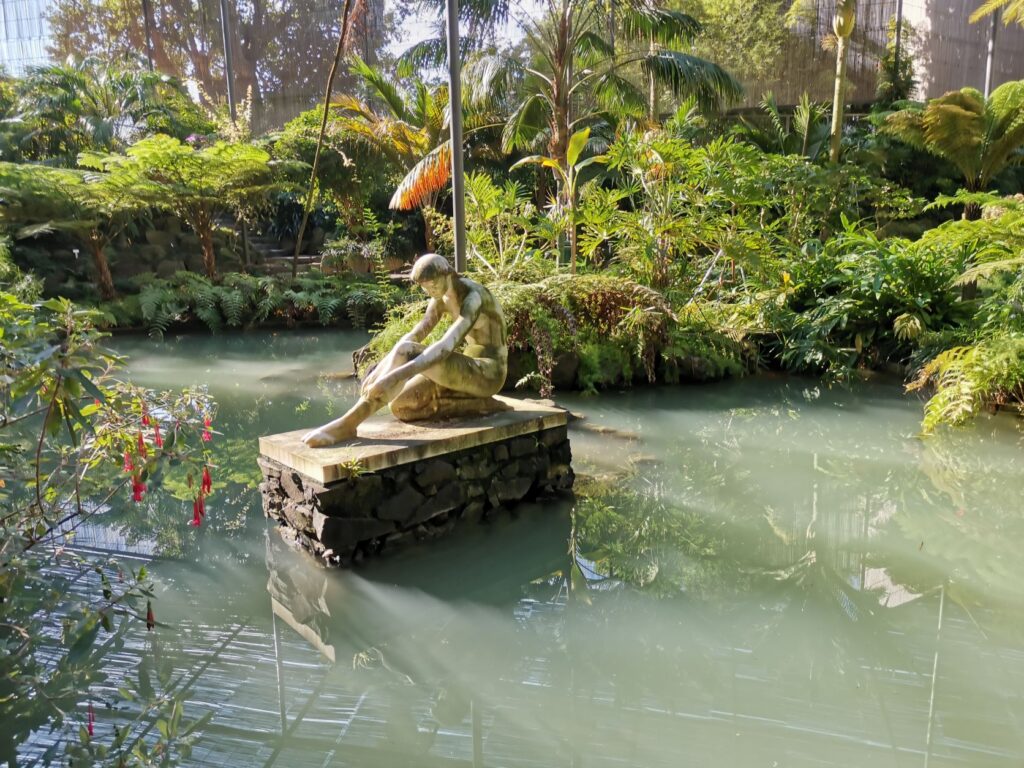
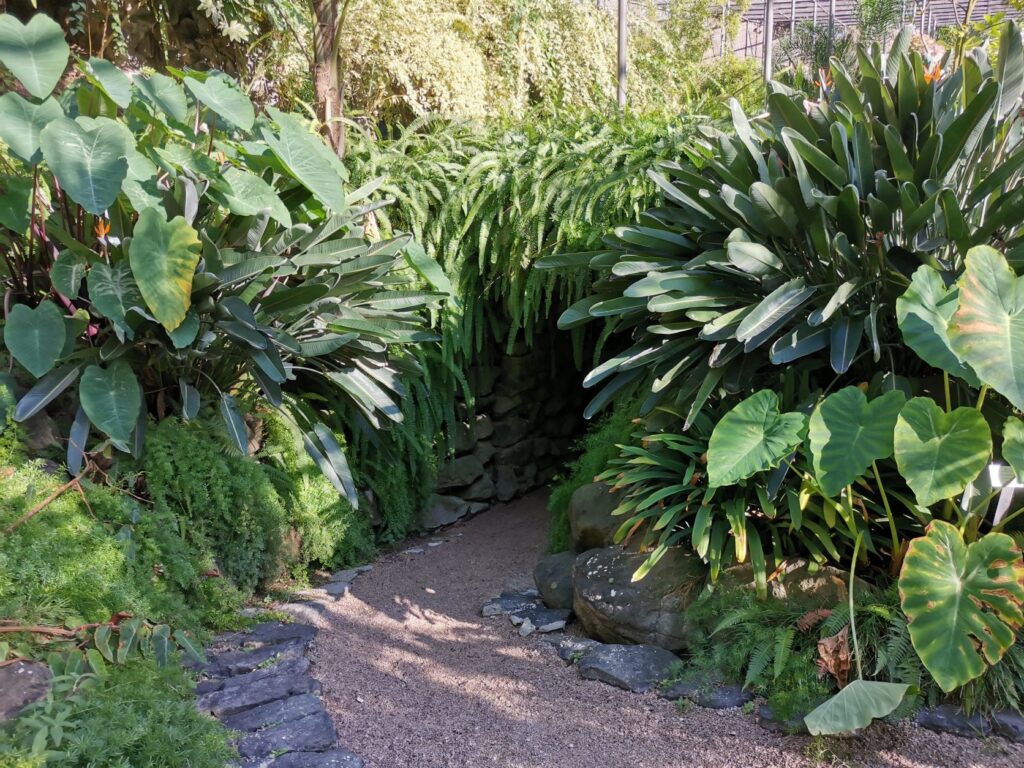
In fact, there are three greenhouses here altogether. The Estufa Fria covers an area of over 8,000 m2. As mentioned, it has no heating and the gaps between the slats are open to the outdoors. At the rear, hugging the back wall of the quarry, are two glass-roofed sections; the Estufa Quente (warm greenhouse), containing coffee plants and mango trees, and the Estufa Doce (sweet greenhouse), which houses cacti and other succulents.
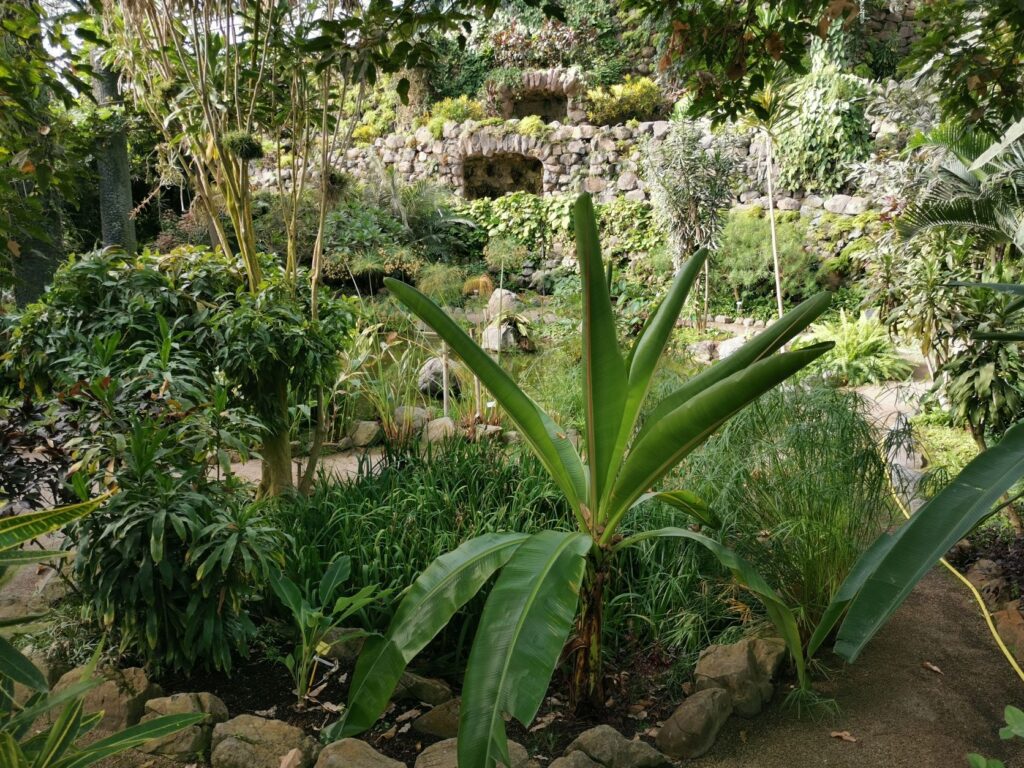
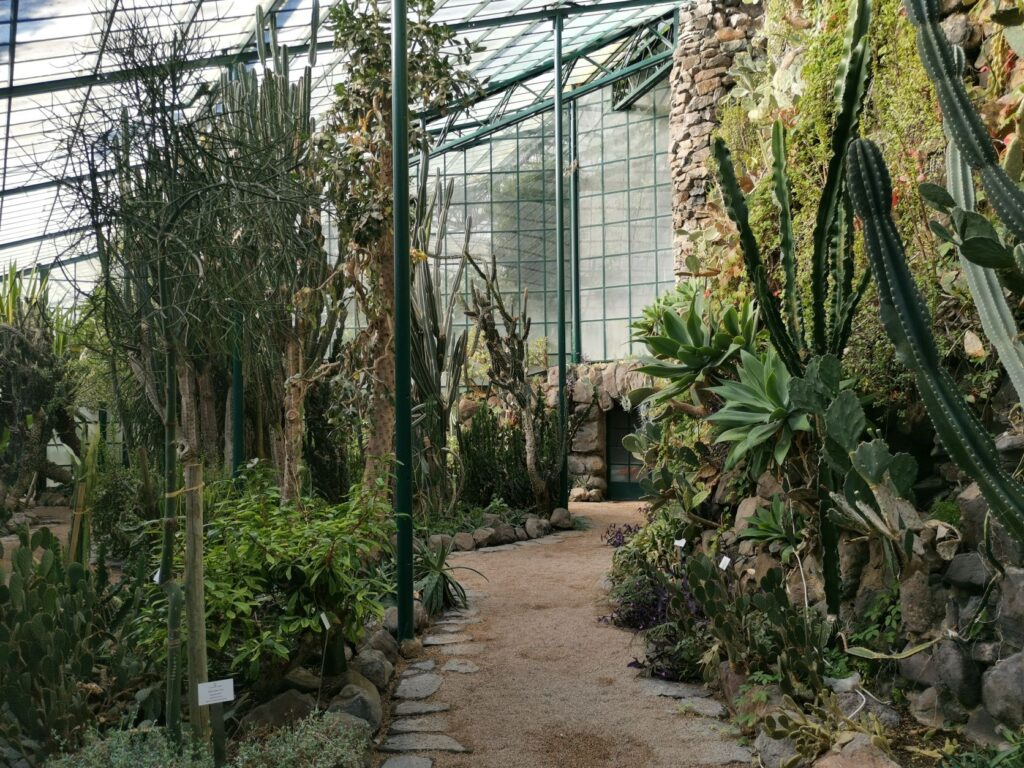
The combined area of the three Estufas is some 11,500 m2. For comparison, the Temperate House in Kew Gardens, the largest surviving Victorian glasshouse in the world, has an area of 4,880 m2[i].
What is the history of this spectacular structure? In 1926 the painter and architect Raul Caraphina discovered a disused basalt quarry adjacent to the park, which a local gardener had been using to shelter plants. Caraphina transformed the space into a massive greenhouse, the basalt walls forming a naturalistic setting for tender and exotic plants, water features and stone structures.
The Estufa Fria opened officially in 1933. In the 1940s the Parque Eduardo VII was developed into the form that can be seen today, adding a lake at the entrance to Estufa and a theatre called `The Nave’ at it side, which extends beneath the park. The two smaller Estufas, which were the idea of Pulido Garcia, an engineer, followed in 1975.
This astonishing horticultural treasure could well be Lisbon’s best kept secret. Information on the internet is scant; here, for the most part, I have relied on the leaflet and map I received on entry. If you should travel to Lisbon, please consider boosting the Estufa Fria’s visitor numbers. I am sure you would find it rewarding.
Article by Paul Tosey
Photos © Paul Tosey
[i] https://en.wikipedia.org/wiki/Temperate_House,_Kew_Gardens accessed 06-11-2022