The research group recently went to Manor Gardens in Eastbourne for a site visit. The site, originally farm land, then became the gardens of The Manor House in the late eighteenth century. In the 1920s it was bought by the Council and opened as a public park. Today the gardens contain a mix of twentieth century additions, such as the sunken garden and the pergola, but also some features from the original gardens made over 200 years ago. One feature we pondered over is called ‘Horse Mound’.
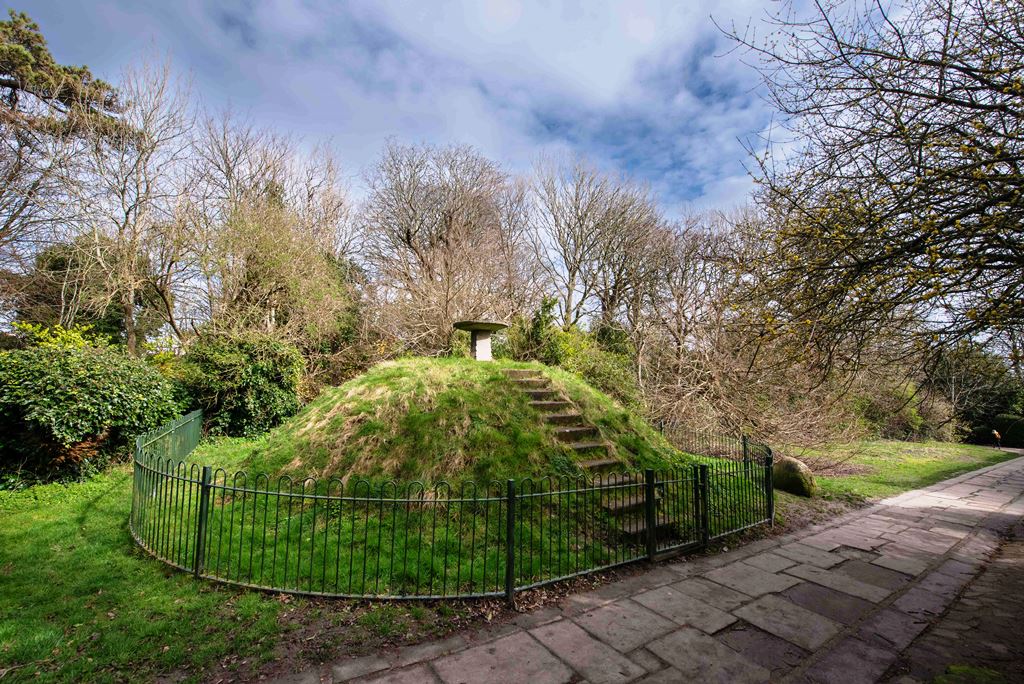
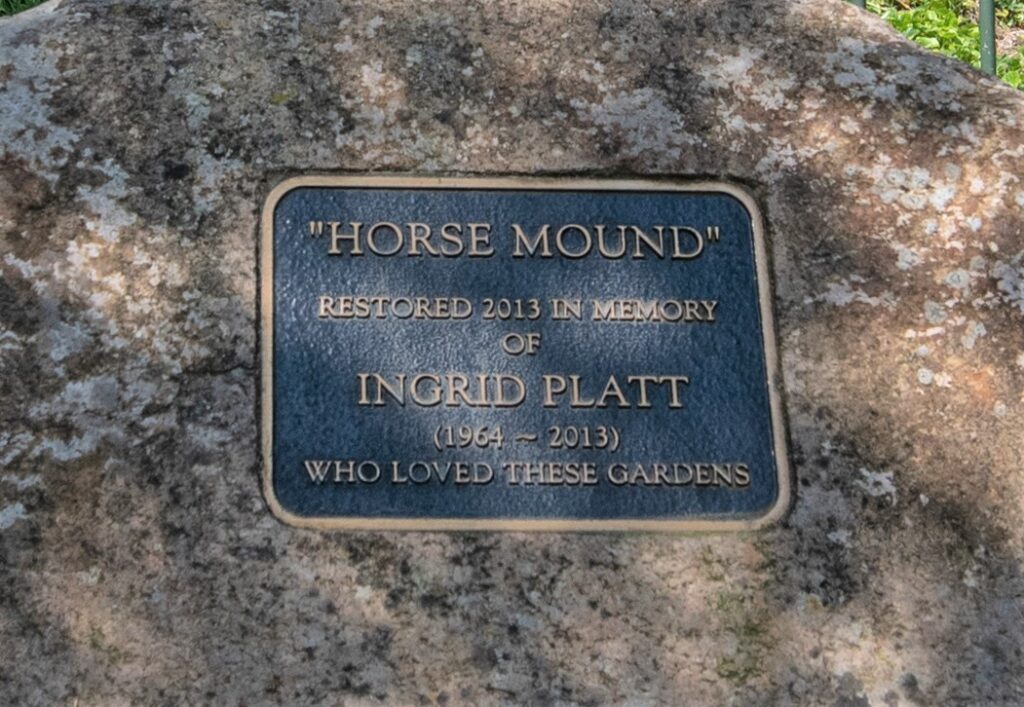
The plaque next to it says “Restored in 2013 in memory of ….”, a clue to the fact that it was there before 2013. It is a grass-covered mound with twelve steps leading to the top on which is currently a stone bird-bath, table top or toadstool? It is about twenty feet high. What was it originally?
Our first thoughts were maybe an ice house, popular in eighteenth century manor houses and estates – but there is no sign of an entrance way. How about a look-out position? A medieval mount? Interestingly there is a nearby rockwork feature in a depression which would have involved significant excavations – was the mound created with the excavated material? The plaque is inset into a large rock, not dis-similar to those found in the dell. But what was the mound for?
After a few internet searches we discovered that “Horse Mound” referred to the previous landowner’s favourite horse and was its final resting place – was it buried standing up? Why is it so tall? If it is a burial mound, there is a precedent here as there is a grave stone nearer the entrance to the garden which commemorates the family’s dog named Duke. When was it created?
Another search led to a rather surprising discovery and an interesting connection. A blog by Robjn Cantus in 2020 showed an image of Ravilious’s triptych called The Tennis Match – see below.
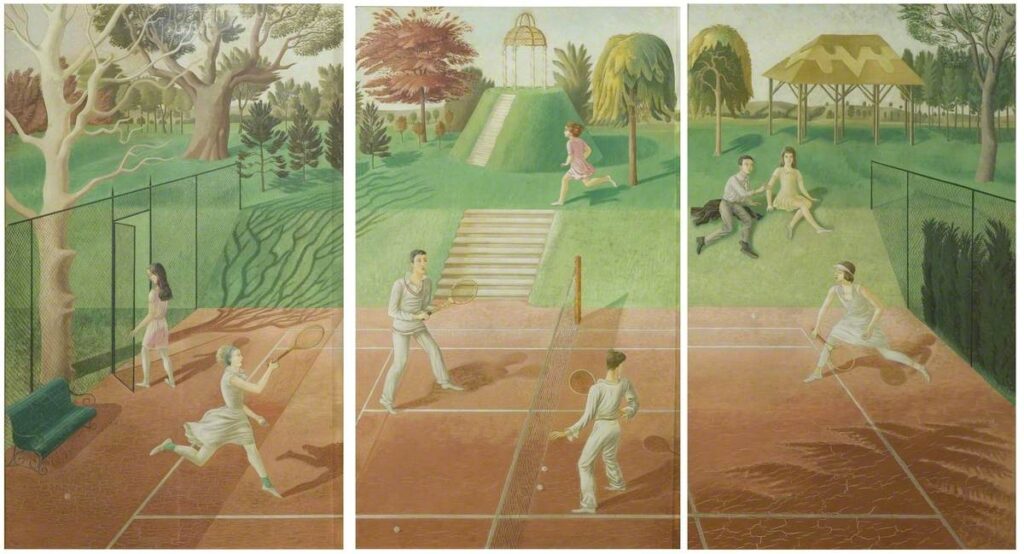
It started to look vaguely familiar. Then there was another image of a woodcut by Ravilious from 1925 – entitled Horse Mound.
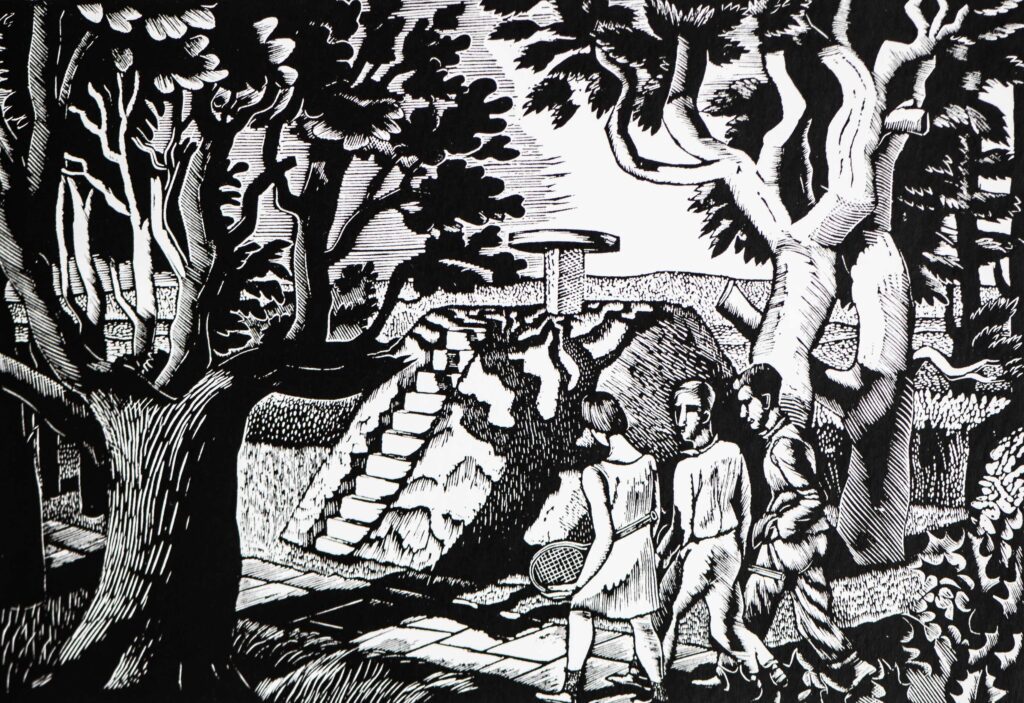
Bingo – this really is our mysterious Horse Mound in Manor Gardens!
Perhaps this shouldn’t have been such a surprise as the Manor House had housed the Towner Art Gallery from 1923 until 2005, when the house was sold and the new Towner Gallery built near the seafront. The key element of their collection was and is the work of Eric Ravilious who had studied and taught at Eastbourne School of Art.
So, mystery partly solved – we know that the ‘Horse Mound’ was there in 1925 when Ravilious sketched it. Now the challenge is to solve the rest of the puzzle. Having made our discoveries we left the site and on the way out saw a well-fed leucistic squirrel watching us from the grass – maybe another tail to follow!