
On a dry, sunny day in August I visited Powerscourt estate in Enniskerry, Co. Wicklow, just south of Dublin. The house was originally a thirteenth century castle which was then extensively altered during the eighteenth century, but a devastating fire in 1974 left it in ruins. It was renovated in 1996 and work was ongoing during our visit. The house, however was not my main interest on this visit – the borrowed view in the Italian Garden and the construction of the grass terraces was the main focus of my excitement.
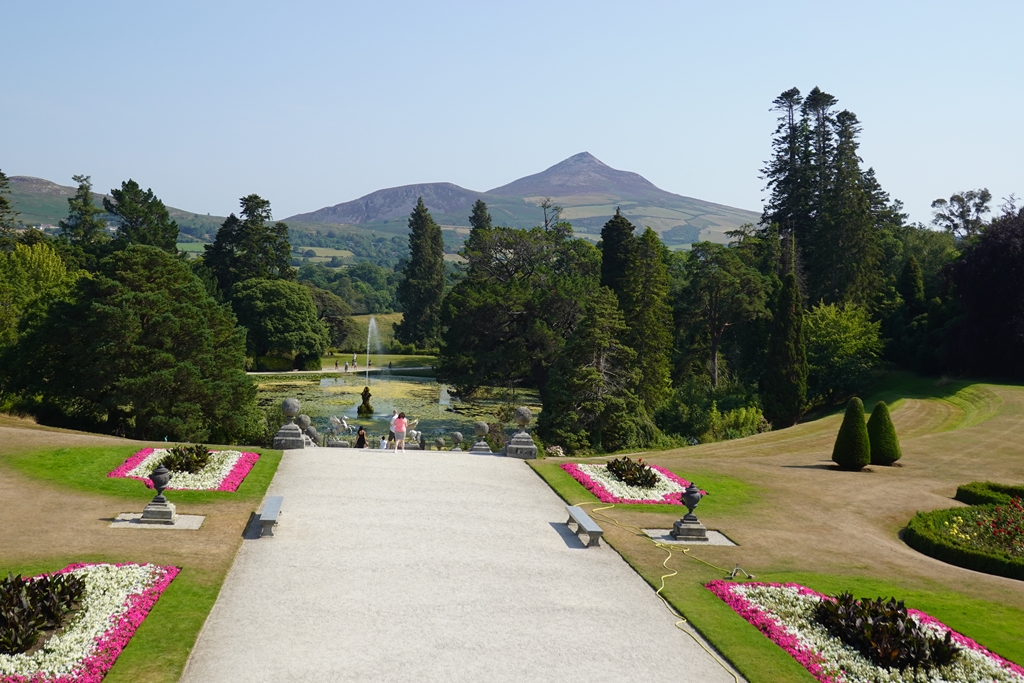
The nineteen hectares of gardens we see today were created by Viscount Powerscourt in the mid-1800s. He had inherited the title and the estate, aged eight, in 1844. The top terrace on the south face of the house has a most astonishing view – a classic example of borrowed scenery, or shakkei in Chinese. Almost in line with the main axis of the Italian garden is Sugar Loaf Mountain. At just over 500m it dominates the skyline together with other peaks in the Wicklow Mountains. The fountain in Triton Lake takes your eye directly to the mountains beyond, in the same way that the main path and the terracing on either side directs your view to the lake. The grass terraces on either side of the axial path are symmetric and involve six different levels with parterres on the second level. Statuary and balustrading also help steer your eyes to the magnificent fountain in the lake.
However, the view was not so wonderful when Mervyn Howard Wingfield, Viscount Powerscourt, inherited the estate in 1844 – there was a ‘hillock’ in the way that partially blocked the view of the lake. His father had made plans for the garden before he died and work had been carried out on the slope on the western side. Excavations were clearly needed to create what we see today – how did they do that I wondered?
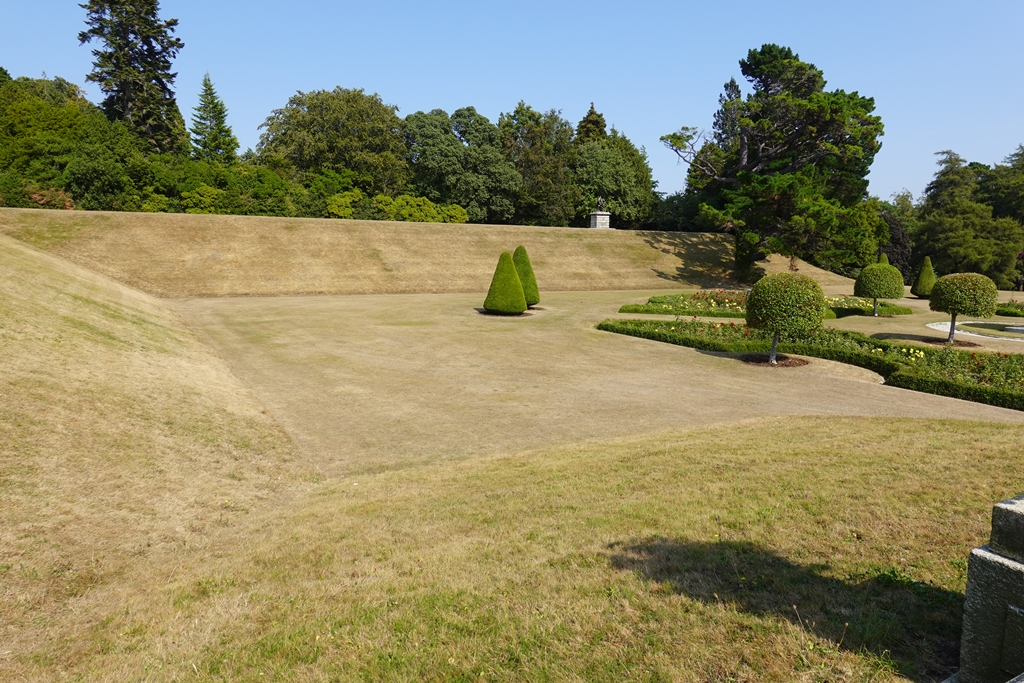
Fortunately, the Viscount recorded descriptions of some of the work involved in his book, A Description and History of Powerscourt, written in 1903. Everything would have been dug by hand – it was not unusual in the eighteenth and nineteenth centuries for hilltops to be flattened for a new house, for example Waddesdon Manor in Buckinghamshire, or for large lakes to be created (think of Capability Brown’s work). Questions came to mind. How much soil was excavated? What did they do with the spoil? Where did they get the manpower from and how long did it all take?
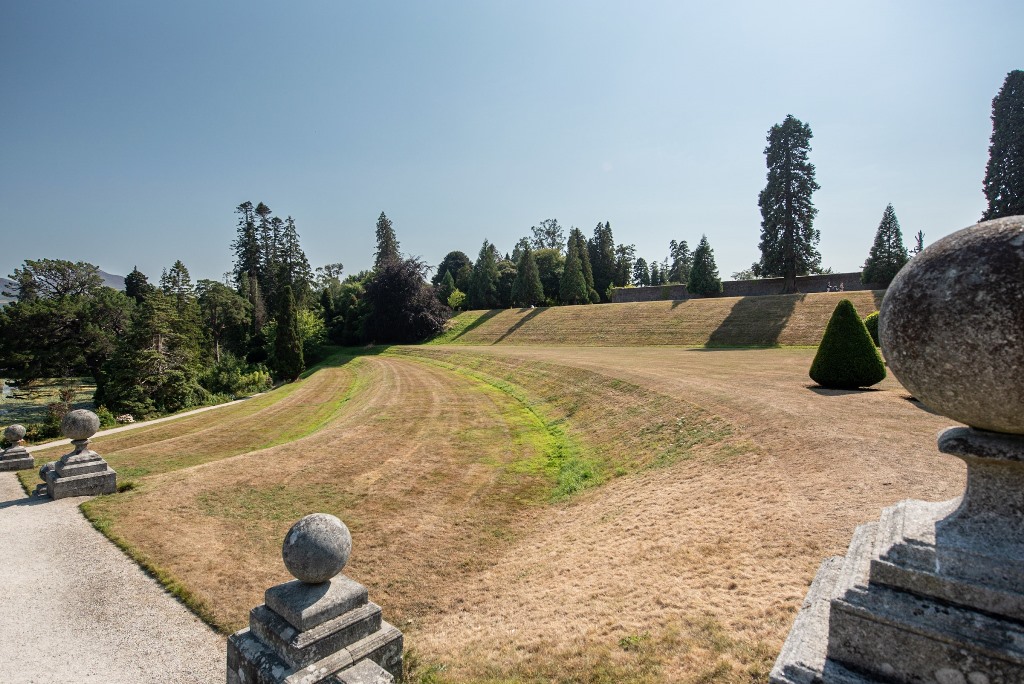
Delving through the Viscount’s book we can find some answers. Labour was very cheap during the 1800s and the Viscount recalls, ‘there were a quantity of poor people on the estate up at Glencree who were wanting employment and we put them to work at about six shillings a week. I had up to 100 men on it at one time’.[1] The excavated spoil was moved to the pond (Triton Lake). They made a roadway down the middle of the terrace, before the flights of steps were built and carted the gravel down the slope and laid it over the whole bottom of the pond ‘about two and a half acres, eight to ten feet thick’. This resulted in the pond then being six feet deep – it had been nearer sixteen feet deep when they started. The gravel bank leaked a great deal but fortunately they found some ‘marly earth’ (which contains a lot of clay) on the eastern side of the terrace which they moved to the bank to make it watertight. The rest of the excavated soil was moved to create the eastern raised terrace to match the other side.
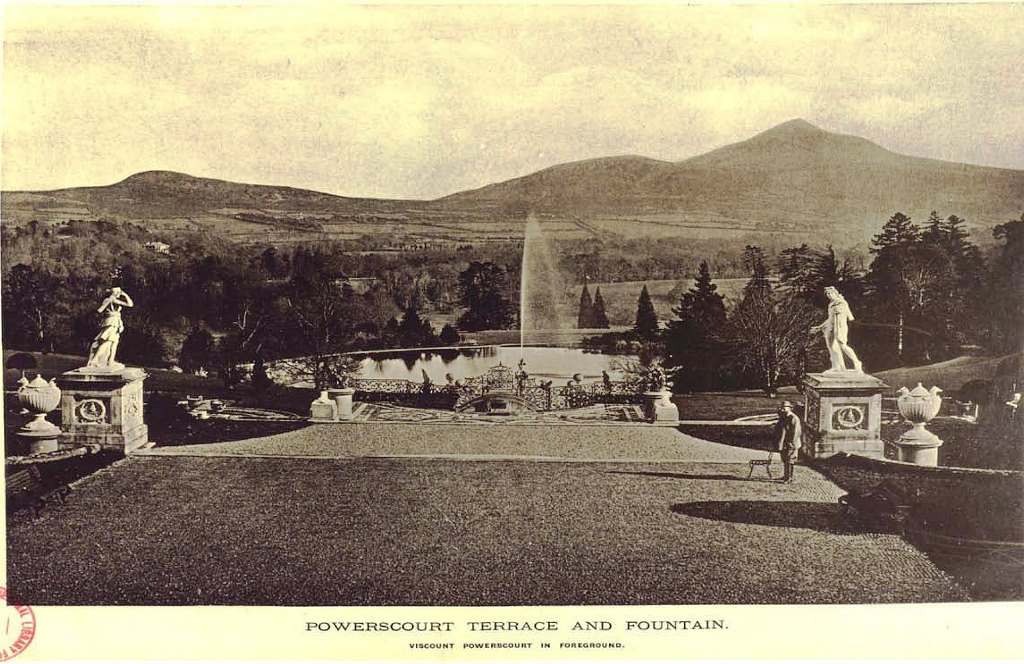
Powerscourt estate marketing material states that the work took a hundred men over twelve years to build. To test this out I re-visited JC Loudon’s advised rate of hand excavation.[2] His rule was one labourer could excavate ten cubic yards in a day on soft ground, plus another labourer to move the excavated material. Using the data about surplus earth being moved to the lake suggests the total volume excavated was in excess of 40,000 cubic yards. With a hundred men at work, half digging and the other half removing soil, this would have taken over eight hundred days to complete, i.e., two and a half years. This does not look promising… However, the Viscount writes: ‘we did part of it, and then stopped on account of the expense and waited until the following summer and then began again’.[3] This would make more sense if they worked for seventy to eighty days each year during good weather. Remember this part of Ireland has an annual rainfall of 741mm (29.2 inches). You had to have a long-term vision in those days – fortunate then that the seventh Viscount Powerscourt lived until 1904 aged 58 – long enough to record the work done on the house and the gardens and to enjoy the results as well as posing in the image below. Not only was my visit in 2022 very enjoyable with stunning views, wonderful statuary and varied planting styles, it also led to a construction quandary to solve – happy days.
[1] Viscount Powerscourt, A description and history of Powerscourt (London: 1903), p. 78.
[2] John Claudius Loudon, An Encyclopaedia of Gardening (London: 1826), p. 378.
[3] Viscount Powerscourt, A description and history of Powerscourt (London: 1903), p. 80.
Article by Pat Dauncey
Photos © Pat and Chris Dauncey