
At the end of October, I was lucky enough to spend a week’s holiday in Sorrento on the Amalfi Coast of Italy. The weather was just beautiful all week, blue skies and temperatures around 24°. We went out every day to see such sites as Pompeii, Herculaneum, Naples, a mozzarella farm and a Limoncello maker.
Gardens of Augustus, Anacapri
One of the trips we took was a boat ride to the nearby island of Capri, beloved home of Gracie Fields, and other well-known celebrities. Once here we explored the town of Capri, before taking a small coach up into the hills, around very narrow bends, to the smaller, more intimate town, of Anacapri.
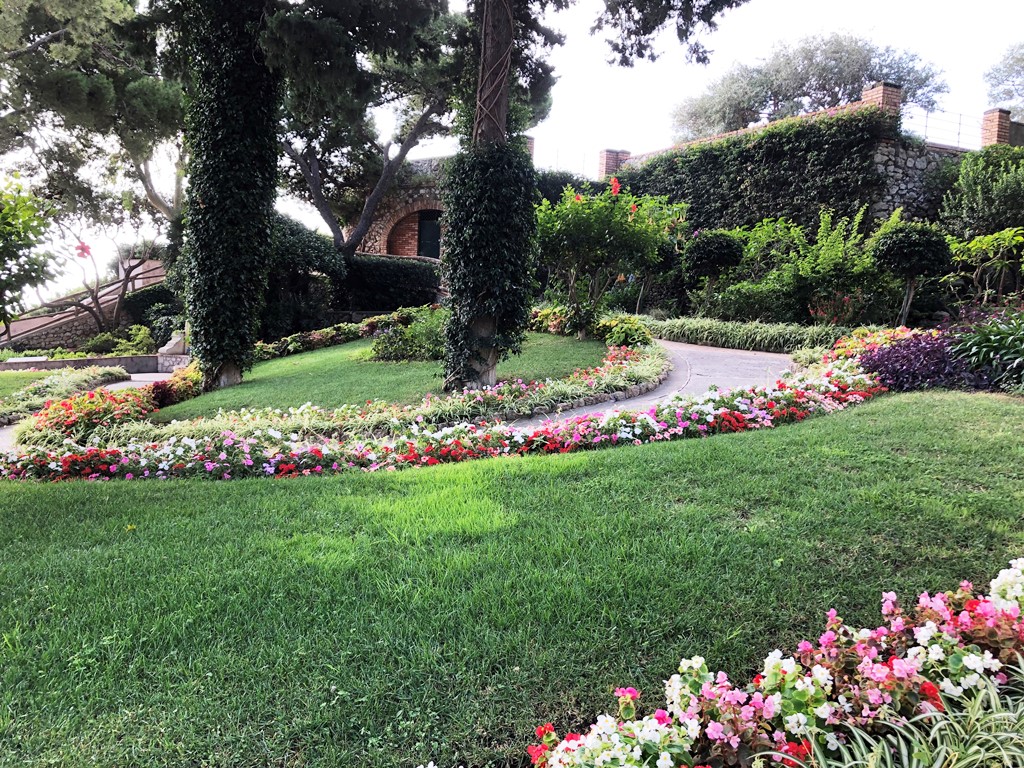
Here we were free to go shopping, have a coffee, or just appreciate the beautiful views. So, I headed to the Gardens of Augustus where at a cost of just one euro one could gain entry. The gardens were originally called the Krupp Gardens, after the German steel industrialist who established his mansion and gardens here in 1900s. However, it was renamed the Gardens of Augustus, after the first Roman Emperor, following the First World War.
The lovely terraces have gentle paths and beds filled with flowers such as dahlias, geraniums, and begonias, with cypress trees and pines. It is said to hold the most important plants on the island. The panoramic views to the sea and the rest of Capri are wonderful. There was an incredibly steep switchback path down the cliff to Marina Piccola, where Friedrich Alfred Krupp used to moor his private yacht when visiting his villa and gardens, but now these are closed due to falling rocks.
Villa Rufolo, Ravello
The second garden I visited was in Ravello, a small but affluent town up in the hills further south, and still overlooking the Amalfi coast. It was a renowned destination for artists, musicians and writers including Virginia Woolf, Greta Garbo, Tennessee Williams, and Jacqueline Kennedy.
The Villa Rufolo was built in the thirteenth century by a wealthy merchant of that name. However, over the centuries it fell into disrepair until it was rescued by a Scottish botanist, Francis Neville Reid, who bought it and turned it into a romantic nineteenth century garden and gothic villa; half ruin, half home. It was subsequently much admired by the elite of the times, including Richard Wagner, who said he had found his ‘magical garden of Klingsor’ and where he wrote the final act of ‘Parsifal’ inspired by the Villa Rufolo and its gardens.
In 1953 the Ravello Music Festival was established in remembrance of Wagner and now takes place every year in the summer. It is based in the Villa Rufolo gardens. The stage for the orchestra projects out over the sea from the lower of the two terraces, with the audience facing the orchestra, the sea and spectacular views.
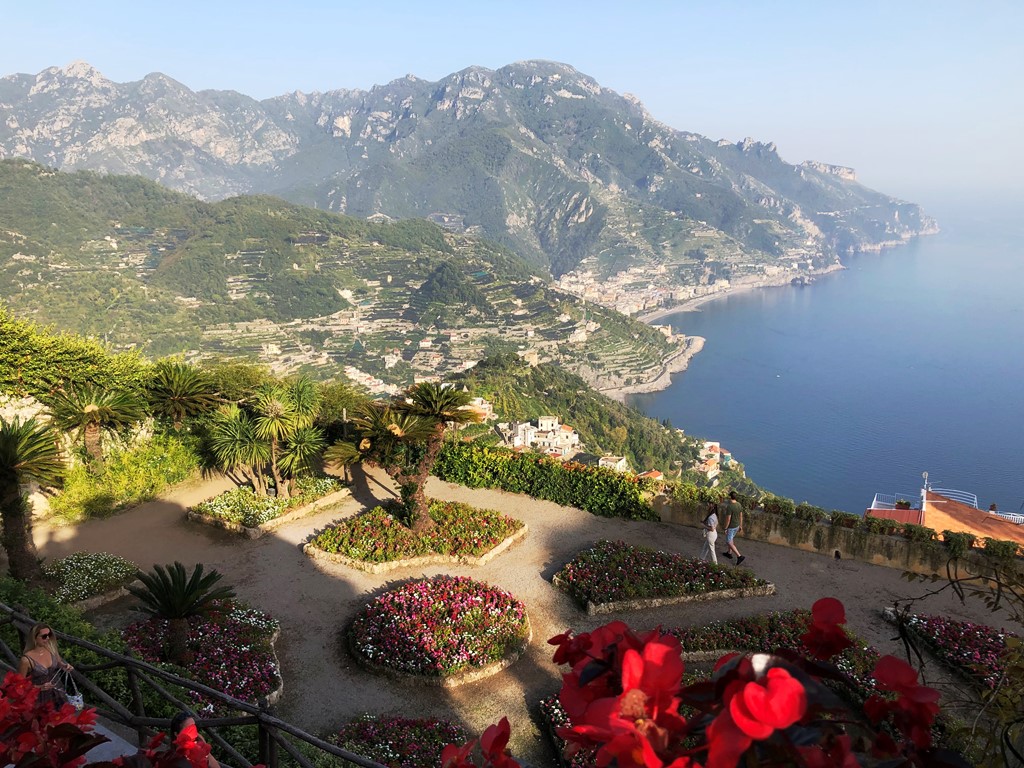
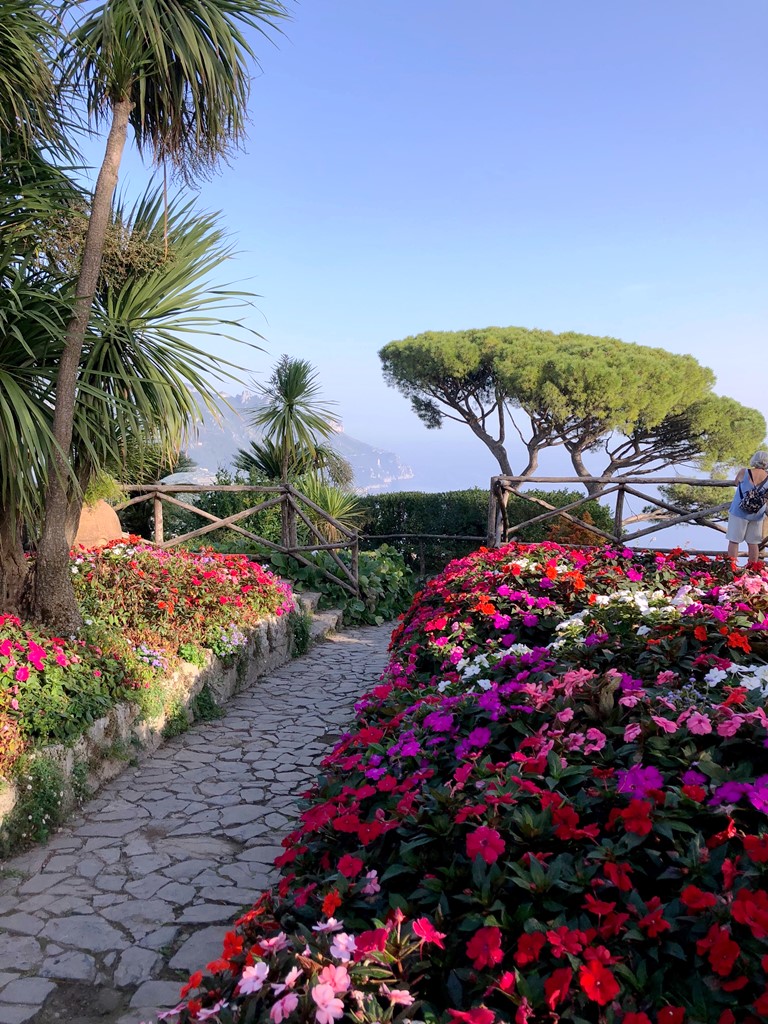
The two terraces, or parterres, are planted with exotic flowers in small geometric beds which can be walked around. Umbrella pines and cypress trees add shade. The whole garden leads towards the terraces and the stunning views. There are fountains and pools, different levels and many steps with various entrances into the villa, whether arch, courtyard or hall.
Apparently, there is a team of gardeners, many descended from the original team employed by Neville Reid to create his romantic vision. When I walked around there seemed to be plants from every corner of the world: oleander, bottle brush, begonia, anthurium and bougainvillea to name just a few, and of course all were flowering in the warm sun.
Article by Maggie Weir-Wilson
Photos © Maggie Weir-Wilson