
The writer in the garden, Gertrude Jekyll, offers advice in Wood and Garden published in 1899:
In the end of July we have some of the hottest of the summer days, only beginning to cool between six and seven in the evening. One or two evenings I go to the upper part of the wood to cut some fern-pegs for pegging Carnation layers, armed with fag-hook and knife and rubber, and a low rush-bottomed stool to sit on … People who are not used to handling Bracken should be careful how they cut a frond with a knife; they are almost sure to get a nasty little cut on the second joint of the first finger of the right hand – not from the knife, but from the cut edge of the fern.
D. H. Lawrence describes a burst of hay-making in a letter to Blanche Jennings, from Eastwood, Notts., 30 July 1908:
From morning till night I have worked in the fields, when the willows have glittered like hammered steel in the morning, till evening when the yellow atmosphere seemed thick and palpable with dense sunshine at evening. You might have found me crawling from side to side on the horse rake, bending, then a jingle as the tines fell behind the winrow, you might have heard the whirr of the file as I sharpened the bristling machine-knife under the hornbeam; you could have seen me high on the load, or higher on the stack, like a long mushroom in my felt hat…
The journalist Robert Dash writes his gardening column for The East Hampton Star, 29 July 1985:
Mid-July through August the garden seems to be a thick, stodgy parade, with all of its outlines dulled and clouded. It seems to lumber along muffled in too much rich living and all of its greens begin to mature and shade like drifts of snow in January twilight. It is like the long, fat summer book whose passages one hoped would go on forever but one whose theme gets to seem a drowned or buried thing.
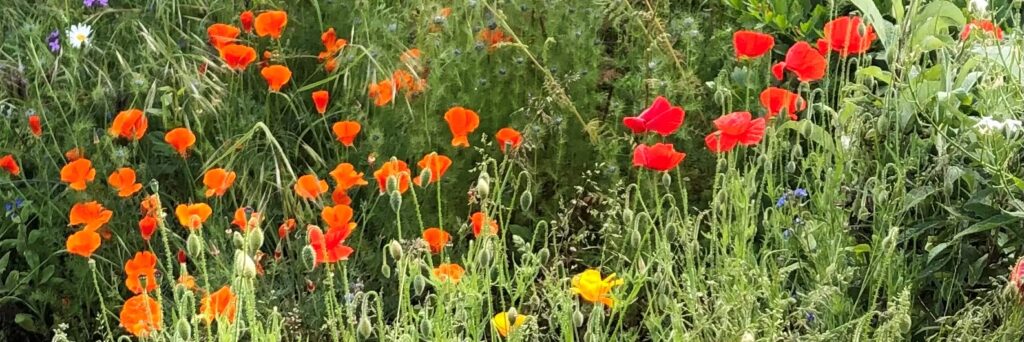
Monday 10 July 1989. Derek Jarman records in his diary:
Lazy high summer. The drowsy bees fall over each other in the scarlet poppies, which shed their petals by noon. Meadow browns and gatekeepers flutter wearily across the shell-pink brambles disputing the nectar with a fast bright tortoiseshell. The bees clamber hungrily up the sour green woodsage. Drifts of mauve rosebay and deep yellow ragwort studded with orange and black burnet caterpillars.
Christopher Lloyd writes to Beth Chatto from Great Dixter in the 1990s:
Thursday 3 July. For the month, we’ve recorded 16cm – more than six inches [of rain]. Main victims have been the old, once-flowering roses. I asked some American visitors who were at Mottisfont Abbey… how it had been there… The roses must have been at their peak, I suggested mischievously. They then had to admit that they were a disaster. If it isn’t the wet, its heat or drought that ruins them, again and again.
We hope you have enjoyed our second edition of Jottings.
If you would like to be reminded every month when the next edition is ready, please enter your email address and name in the Monthly Jottings box on the right then click on Ask here.
We look forward to seeing you all next month.