
I have been volunteering at the Sussex Prairie Garden, near Henfield, for more than four years now and the time has come to spill the beans about what happens when the public isn’t there.
The shocking truth is that most of these intervening months, from mid-October until the following June, are spent playing party games. These include gift-wrapping green banana plants; hunting the `weed of the week’; and stapling the label to the plant pot (a variation on pin-the-tail-on-the-donkey – there are no blindfolds but it’s just as challenging due to the malfunctioning staplers). Indeed, there are so many games that the closed months are a veritable festival of fun.
By the way, if you are objecting that the green banana, Musa basjoo, is not a prairie plant, well done for staying alert. In fact, the Prairie Garden site also has an exotic garden that you pass through from the main entrance and just before you encounter the pigs (I’m not being derogatory about us volunteers, there are two real pigs whose job is to turn garden waste into bacon(unless they have the good fortune to be retired to an animal sanctuary).
Here are two of the most prominent games that take place on the prairie itself.
Trash and burn
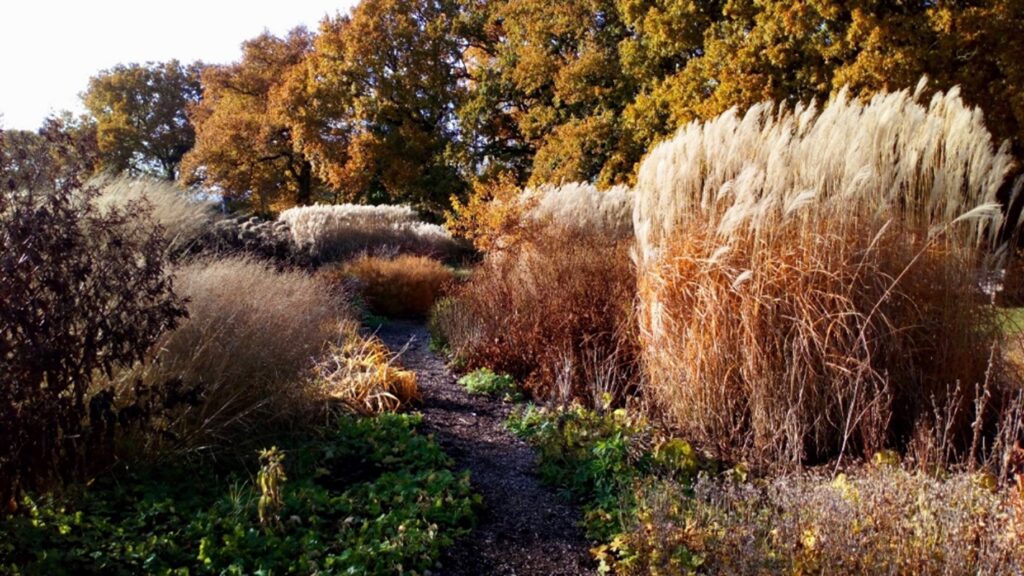
One of the joys of volunteering in this garden is arriving to find the sun shining through head-height dried grasses on a crisp, clear autumn day. It is a privilege to witness portions of the prairie’s life-cycle that are out of season yet so glorious.
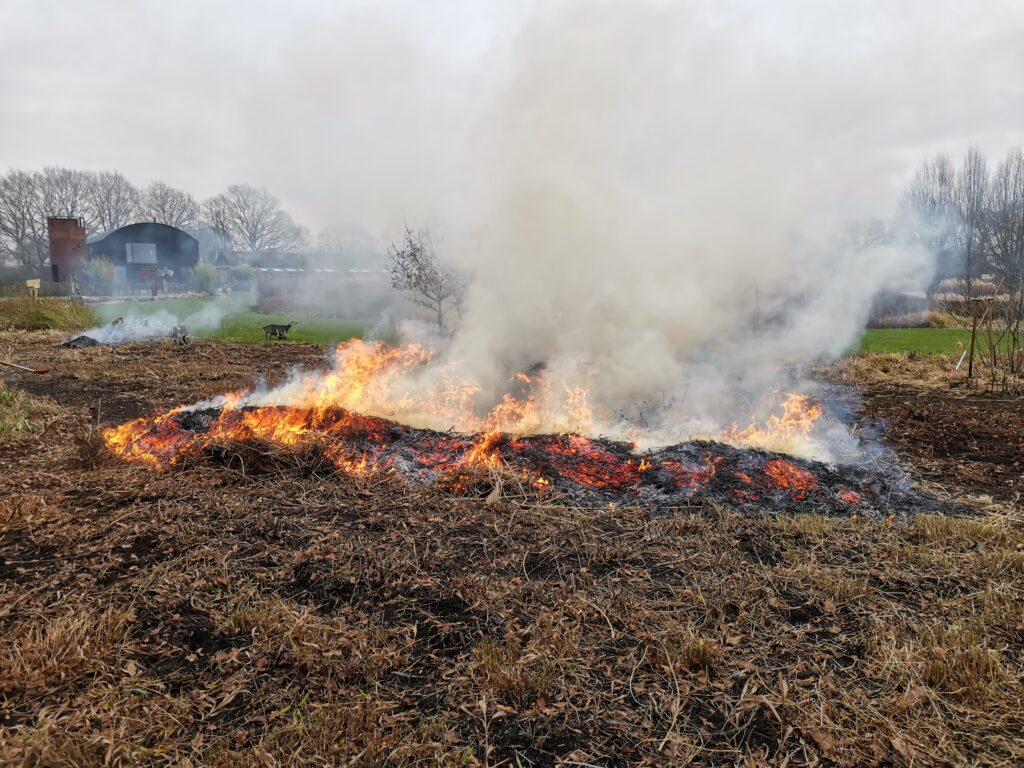
Later, usually in January, a spectacular game marks the end of one cycle and the beginning of the next. Picasso claimed (allegedly) that every act of creation begins with an act of destruction. Personally I enjoy a spot of destructive gardening – with the longer-term creation in view, of course – and what could be more wickedly satisfying yet still legal than to trash and burn an RHS partner garden?
Of course, all the games have important health and safety considerations, this one in particular. Don’t try it at home! Or in any public place! And don’t blame me (or flame me) if you ignore this advice!
The objective of this game is to reduce the winter prairie of dried perennials to a flat, smouldering, ash-strewn plain. I’m told that this mimics what happens naturally in the North American prairies.
How to play: first, using hedge trimmers and other cutting implements, chop down the tall, dried plants close to the base; next, take pitchforks and rakes to assemble the dried plant matter into large heaps on the pathways through the beds (to avoid intense heat directly on top of over-wintering plants); then, take up the butane firelighter – its pop and whoosh are so satisfying! – aim the lighter at one of the heaps (having checked first that no-one is standing immediately down-wind), stand back and watch the flames devour it all!
Mulch ado about nothing
On a beautiful, warm, sunny spring day in March, buzzards and a stunning red kite swoop and soar overhead. Paul McBride’s big green tractor is parked on the grass next to one of the huge Prairie Garden beds, its trailer full of steaming, pungent compost, tipped up and ready to unload.
This is the setting for a game that involves two teams who are supposed to co-operate. Team A lines up three wheelbarrows behind the trailer and uses pitchforks to fill them with compost (the latest fleet of barrows are all named – Love’s Poison Barrow, Sir Mo Barrah, Captain Jack Barrow – you get the idea – and decorated accordingly). Players wheel the barrows across the bed, tip their loads onto the ground then return to the tractor for a refill. Team B rakes the compost into a thick, even blanket of mulch.
Members of Team B are allowed to order Team A to tip the barrowloads in specified places to ensure even coverage; orders which members of Team A can ignore if they are feeling mischievous or that Team B are being a bit too uppity. The workers make sure things don’t get out of hand and stop the volunteers doing things they shouldn’t, such as inadvertently covering young Echinacea seedlings. The workers also participate as team members, which is impressive multi-tasking if you ask me.
Perhaps the best fun in this game, sadly the exclusive preserve of the workers, is to sit at the controls of the tractor and jiggle the trailer in order to loosen the residue of sticky compost that sits at the top of the trailer and stubbornly refuses to come within reach. It takes real skill to avoid an avalanche that half-buries the players waiting by the wheelbarrows.
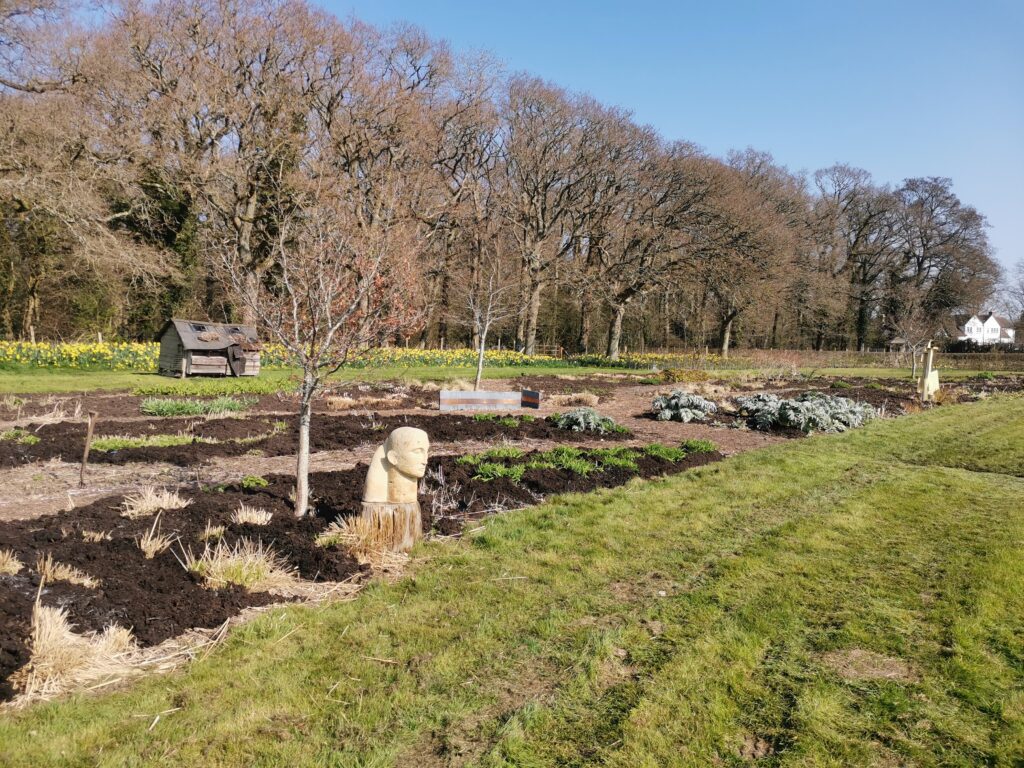
To call mulching a game hardly does it justice. It goes on for weeks and epitomises that football cliché of the season being a marathon not a sprint. Indeed, it lasts for so long that it is no good wishing for the end to arrive. Just like the Olympics, it is all about the taking part. I even wonder sometimes why we do it. Is it truly beneficial for the garden? Is it a grand metaphor for life, with its relentless routines that we continue to perform with faint hope of any future reward? Is it merely a ploy to `disappear’ the huge pile of compost that sits in the next field?
Whatever the answer, it still feels miraculous to realise that these sparse beds will be bursting with a multitude of tall, thriving plants in just a few weeks’ time.
Party food
Some people, rather unkindly I feel, have questioned the idea that these activities are games. They dare to suggest that they are `work’ or `chores’ or even `hard labour’. Well, just to prove that they are wrong, everyone knows that parties have cake and, guess what, we always have cake at coffee time. It could be lemon drizzle, coffee and walnut, lemon and blueberry, rhubarb and ginger, chocolate…. the list goes on. All delicious, served by Pauline McBride and her Mum, Pat, then eaten around the log burner or on the terrace while sipping tea or coffee and chatting with all the lovely people who gather to work, I mean play, there. What bliss. Which just goes to show that, by volunteering here, you can have your cake and eat it too.
Article by Paul Tosey
Sussex Prairie Garden opens for 2022 on Wednesday 1 June. For full details see: https://www.sussexprairies.co.uk