

Notice: Function _load_textdomain_just_in_time was called incorrectly. Translation loading for the acf domain was triggered too early. This is usually an indicator for some code in the plugin or theme running too early. Translations should be loaded at the init action or later. Please see Debugging in WordPress for more information. (This message was added in version 6.7.0.) in /home/u60577/domains/staging.sussexgardenstrust.org.uk/public_html/wp-includes/functions.php on line 6260

Deprecated: Creation of dynamic property ACF::$fields is deprecated in /home/u60577/domains/staging.sussexgardenstrust.org.uk/public_html/wp-content/plugins/advanced-custom-fields-pro/includes/fields.php on line 138

Deprecated: Creation of dynamic property acf_loop::$loops is deprecated in /home/u60577/domains/staging.sussexgardenstrust.org.uk/public_html/wp-content/plugins/advanced-custom-fields-pro/includes/loop.php on line 28

Deprecated: Creation of dynamic property ACF::$loop is deprecated in /home/u60577/domains/staging.sussexgardenstrust.org.uk/public_html/wp-content/plugins/advanced-custom-fields-pro/includes/loop.php on line 269

Deprecated: Creation of dynamic property ACF::$revisions is deprecated in /home/u60577/domains/staging.sussexgardenstrust.org.uk/public_html/wp-content/plugins/advanced-custom-fields-pro/includes/revisions.php on line 387

Deprecated: Creation of dynamic property acf_validation::$errors is deprecated in /home/u60577/domains/staging.sussexgardenstrust.org.uk/public_html/wp-content/plugins/advanced-custom-fields-pro/includes/validation.php on line 28

Deprecated: Creation of dynamic property ACF::$validation is deprecated in /home/u60577/domains/staging.sussexgardenstrust.org.uk/public_html/wp-content/plugins/advanced-custom-fields-pro/includes/validation.php on line 215

Deprecated: Creation of dynamic property acf_form_customizer::$preview_values is deprecated in /home/u60577/domains/staging.sussexgardenstrust.org.uk/public_html/wp-content/plugins/advanced-custom-fields-pro/includes/forms/form-customizer.php on line 28

Deprecated: Creation of dynamic property acf_form_customizer::$preview_fields is deprecated in /home/u60577/domains/staging.sussexgardenstrust.org.uk/public_html/wp-content/plugins/advanced-custom-fields-pro/includes/forms/form-customizer.php on line 29

Deprecated: Creation of dynamic property acf_form_customizer::$preview_errors is deprecated in /home/u60577/domains/staging.sussexgardenstrust.org.uk/public_html/wp-content/plugins/advanced-custom-fields-pro/includes/forms/form-customizer.php on line 30

Deprecated: Creation of dynamic property ACF::$form_front is deprecated in /home/u60577/domains/staging.sussexgardenstrust.org.uk/public_html/wp-content/plugins/advanced-custom-fields-pro/includes/forms/form-front.php on line 600

Deprecated: Creation of dynamic property acf_form_widget::$preview_values is deprecated in /home/u60577/domains/staging.sussexgardenstrust.org.uk/public_html/wp-content/plugins/advanced-custom-fields-pro/includes/forms/form-widget.php on line 34

Deprecated: Creation of dynamic property acf_form_widget::$preview_reference is deprecated in /home/u60577/domains/staging.sussexgardenstrust.org.uk/public_html/wp-content/plugins/advanced-custom-fields-pro/includes/forms/form-widget.php on line 35

Deprecated: Creation of dynamic property acf_form_widget::$preview_errors is deprecated in /home/u60577/domains/staging.sussexgardenstrust.org.uk/public_html/wp-content/plugins/advanced-custom-fields-pro/includes/forms/form-widget.php on line 36

Notice: Function _load_textdomain_just_in_time was called incorrectly. Translation loading for the all-in-one-seo-pack domain was triggered too early. This is usually an indicator for some code in the plugin or theme running too early. Translations should be loaded at the init action or later. Please see Debugging in WordPress for more information. (This message was added in version 6.7.0.) in /home/u60577/domains/staging.sussexgardenstrust.org.uk/public_html/wp-includes/functions.php on line 6260

Notice: Function _load_textdomain_just_in_time was called incorrectly. Translation loading for the astra-addon domain was triggered too early. This is usually an indicator for some code in the plugin or theme running too early. Translations should be loaded at the init action or later. Please see Debugging in WordPress for more information. (This message was added in version 6.7.0.) in /home/u60577/domains/staging.sussexgardenstrust.org.uk/public_html/wp-includes/functions.php on line 6260

Warning: Cannot modify header information - headers already sent by (output started at /home/u60577/domains/staging.sussexgardenstrust.org.uk/public_html/wp-content/plugins/advanced-custom-fields-pro/includes/forms/form-widget.php:36) in /home/u60577/domains/staging.sussexgardenstrust.org.uk/public_html/wp-content/plugins/wp-fastest-cache/inc/cache.php on line 504

Notice: Function _load_textdomain_just_in_time was called incorrectly. Translation loading for the complianz-gdpr domain was triggered too early. This is usually an indicator for some code in the plugin or theme running too early. Translations should be loaded at the init action or later. Please see Debugging in WordPress for more information. (This message was added in version 6.7.0.) in /home/sites/8a/1/128bc4c1c9/staging_html/wp-includes/functions.php on line 6114

Notice: Function _load_textdomain_just_in_time was called incorrectly. Translation loading for the astra domain was triggered too early. This is usually an indicator for some code in the plugin or theme running too early. Translations should be loaded at the init action or later. Please see Debugging in WordPress for more information. (This message was added in version 6.7.0.) in /home/sites/8a/1/128bc4c1c9/staging_html/wp-includes/functions.php on line 6114

Notice: Function _load_textdomain_just_in_time was called incorrectly. Translation loading for the astra-addon domain was triggered too early. This is usually an indicator for some code in the plugin or theme running too early. Translations should be loaded at the init action or later. Please see Debugging in WordPress for more information. (This message was added in version 6.7.0.) in /home/sites/8a/1/128bc4c1c9/staging_html/wp-includes/functions.php on line 6114

Warning: Cannot modify header information - headers already sent by (output started at /home/sites/8a/1/128bc4c1c9/staging_html/wp-includes/functions.php:6114) in /usr/share/php/wp-stack-cache.php on line 1119

Warning: Cannot modify header information - headers already sent by (output started at /home/sites/8a/1/128bc4c1c9/staging_html/wp-includes/functions.php:6114) in /usr/share/php/wp-stack-cache.php on line 1120
Summer reading - Sussex Gardens Trust

Summer reading

2 July 2022

The Ornamental Wilderness in the English Garden. Unicorn, 2022.  James Bartos. 296pp, hard-back, coloured illustrations throughout. RRP £30.

This book opens with the story of trees, their uses and meaning in history. In their timelessness they seem to represent the past, which is where Bartos starts, establishing meaning and myth from classical and biblical understandings of groves. The ancients’ respect for trees and their spirits meant they were used for both private contemplation and collective worship in ‘verdant cathedrals’. Nearer our own time Bartos reminds us of John Evelyn’s ‘wooden walls’, trees used for naval defence purposes as they were in ancient Greece, before arriving at his focus, the eighteenth century, where the arrangement of trees in a wilderness became part of the designed pleasure garden. He concludes that the term was most used in the period 1700-1731 when the wilderness was at the height of its popularity (examples at Wilton, Ham and Sayes Court), and then again when looking back in the later eighteenth century as the idea of formal designs using trees was already disappearing in favour of the more ‘natural’ landscape. An example which Defoe considered beautiful in 1724 had already become outgrown by 1742 and was thought to disagree with ‘modern taste’.

During the short period of its popularity we learn that the wilderness had very definite characteristics: the extent of the true wilderness was clearly defined, and as you walked into it from the surrounding garden its delights were immediately obvious and to be enjoyed; it was part of the inner garden, never in the park; it was for walking, not riding, and the site was flat; it was to be found near the house, and planted not for timber with its profit motive, but for shade and social pleasure, possibly accompanied by ‘wine and collations’. The planting structure used paths lined by hedges restricted in height, punctuated by trees allowed to grow out loosely. Flowering shrubs should be planted in the ‘quarters’, and the paths lined with small decorative flowers. While the wilderness had a degree of regularity, the St. Andrew’s cross being the most common outline, irregular curves had an important function within, offering the stroller new events at every turn and surprising features such as a sculpture or fountain where several paths met, either in the centre or perhaps in an enclosed cabinet. These diversions were considered ‘trifling if not ridiculous’ later in the century. The height of the hedges which lined the paths was debated. The issue at stake was whether you could see others approaching along a different path, and so whether such an encounter with another stroller would be a surprise (pleasant or otherwise).

Bartos examines the origins of the form, and shows evidence of design with trees as far back as the Medici villas and other early French and Dutch designs, causing him to make a plea for the avoidance of labelling gardens such as Dyrham as ‘Dutch’ or ‘Franco-Dutch’, reasoning that contemporary garden visitor descriptions reveal a much broader use of the term wilderness than is generally found today. However, he stresses throughout that the wilderness was an important and special feature of the English garden in the early eighteenth century.

Maintaining the wilderness was an intensive and ongoing problem, described by Switzer as ‘a prodigious deal of clipping’ which could simply be achieved by a scythe on a pole. At Hampton Court the wilderness (now called the maze) had its own garden staff of twenty-five. Indeed, the conflation of the forms of maze with its more geometric design and the similar but distinct wilderness accompanies descriptions of the feature through the seventeenth and eighteenth century and is here well illustrated by contemporary prints and plans. Bartos also compares available ground views with the more familiar bird’s-eye view of properties and their wildernesses (and mazes) to good effect, the ground views being able to show the experience of the garden for the visitor, with entrances and exits to the wilderness, and the effect of the various heights of hedges, as opposed to the exhibitionist aspirations of the owner found in the more general bird’s-eye view.

The aftermath of the wilderness is scrutinized and some misconceptions concerning the legacy of the wilderness are dismissed, the principal one being that the wilderness somehow morphed into the shrubbery by neglect. These, he maintains, are two quite distinct features with their own characteristics, ruling out the possibility that wildernesses were somehow converted into or became shrubberies. He warns us against reconstructions of wildernesses which had been felled as yew is often substituted for hornbeam, but a few survive as valuable cultural references, such as at Bramham.

Bartos has turned his thesis into a thoroughly enjoyable, readable and informative book. Hard-back and beautifully produced using thick, quality paper, it is liberally illustrated in colour throughout. The copious illustrations illuminate the text, an effect which is enhanced by the easy to read lay-out. End notes, an extensive bibliography with primary sources arranged by topic and a comprehensive index complete a delightful and useful study of this intriguing, but until now little understood, feature of the English garden.

Reviewed by Judy Tarling www.judytarling.com
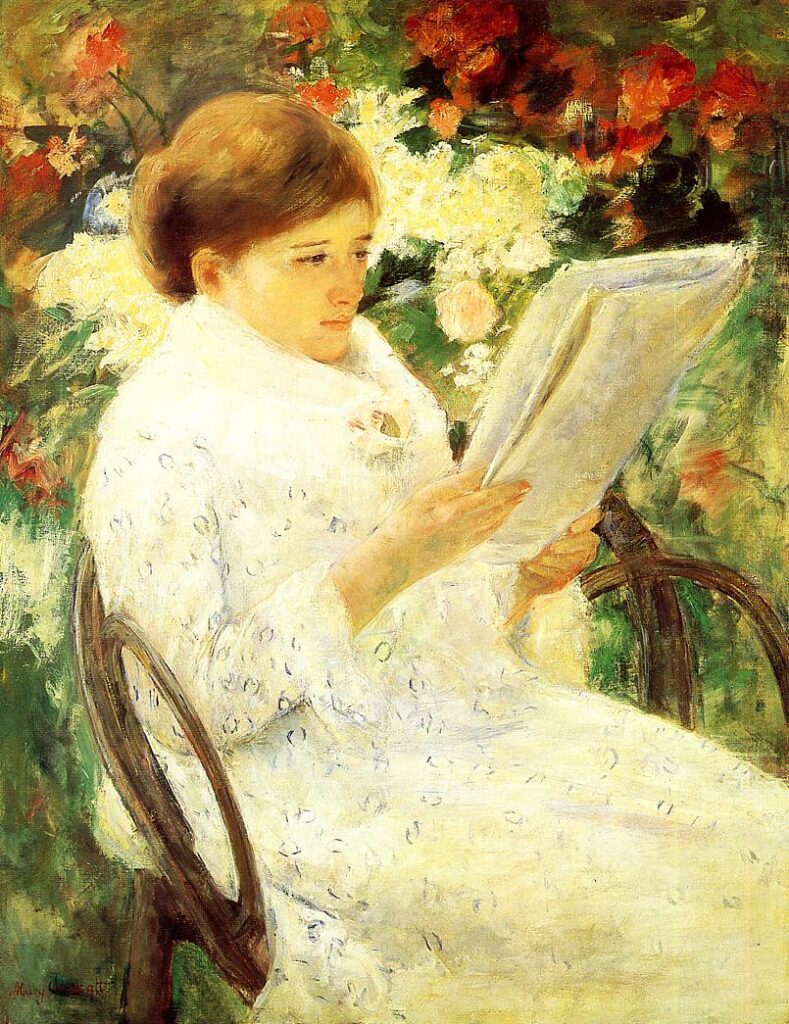

Woman Reading in a Garden. Mary Cassatt. Art Institute of Chicago. Image: public domain.

What are your favourite garden books for summer reading? Fiction or fact? Classic or contemporary? To send your suggestions, contact us here.


← Back to Notebook
Scroll to Top