
Little did we need to know it but inadvertently our 2022 Scottish safari included two locations, Drummond Castle and Culross Palace, which feature in Outlander, a TV series of which we were only vaguely aware.
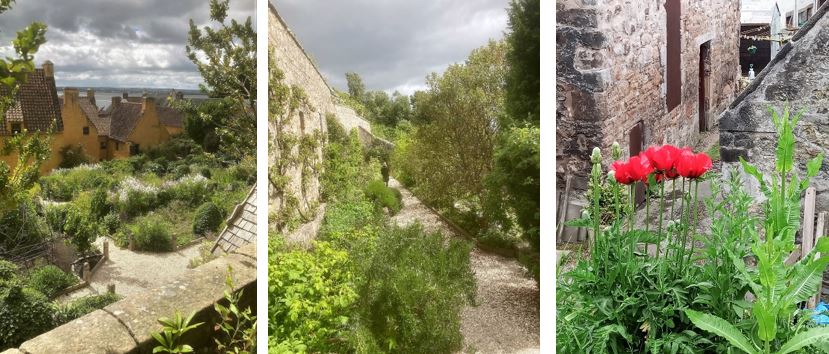
Culross on the River Forth is, according to the NT Scotland, ‘Scotland’s most complete example of a burgh of the seventeenth and eighteenth centuries’. The principal building is the Palace, never actually a royal palace but the house of a rich merchant, Sir George Bruce (c1550-1625), who traded in timber, salt and coal (he is reputed to have tunnelled the first undersea coal mine). The palace has very fine interiors but the surprise is the sheltered garden of perhaps quarter of an acre immediately behind it. One steps out from the house at first floor level onto a grid of paths which rise steeply up the hillside. It is a delight.
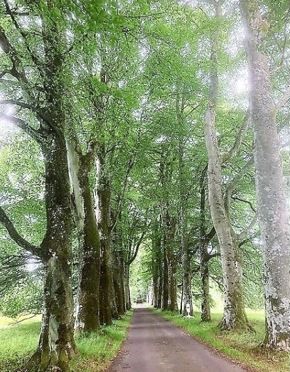
The grounds of Versailles are so grand that it is hard to imagine a Scottish garden being chosen to represent it on film. Drummond Castle in Perthshire clearly fitted the bill. Having driven for perhaps a mile and a half up a narrow carriage drive, lined with tall beech trees, arrow-straight for the first half mile, the lovely lady behind the till was having none of my attempt to secure a discount on entry, my mother being a Drummond (although somewhat lower down the social scale).
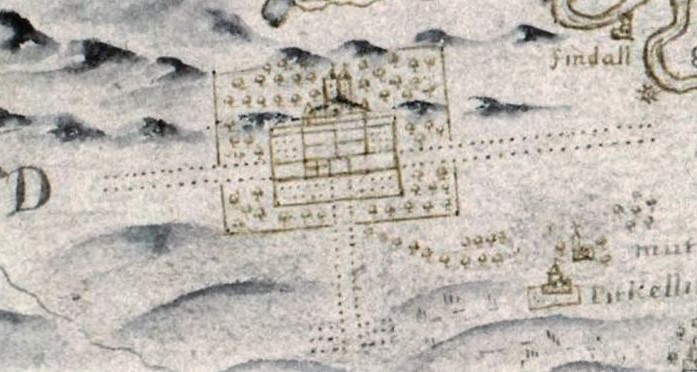
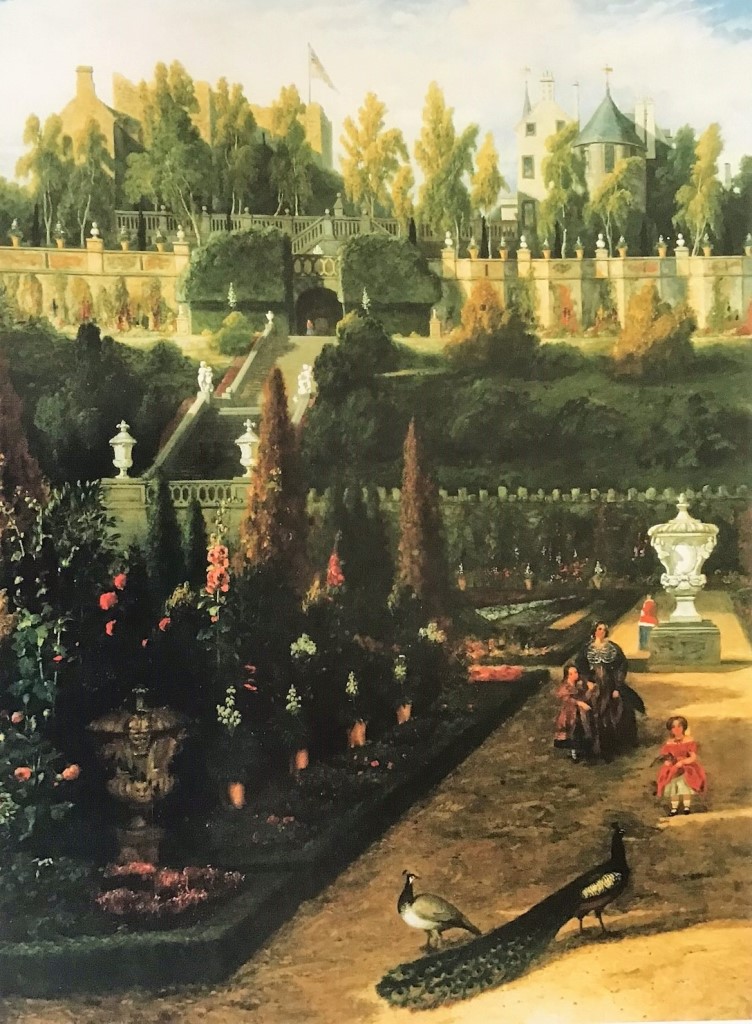
Whilst some form of garden existed as early as the 1680s, the current garden was laid out in the decades following 1818 when Lewis Kennedy (1789-1877) was hired as factor. Whether he or Charles Barry (or both) was responsible for the design which we see today is unclear but the result is spectacular; the way in which the terrace punctuated by white busts, the castle behind, dominates a steep slope with a garden at its foot is somewhat reminiscent of the gardens at Powis Castle in Wales.
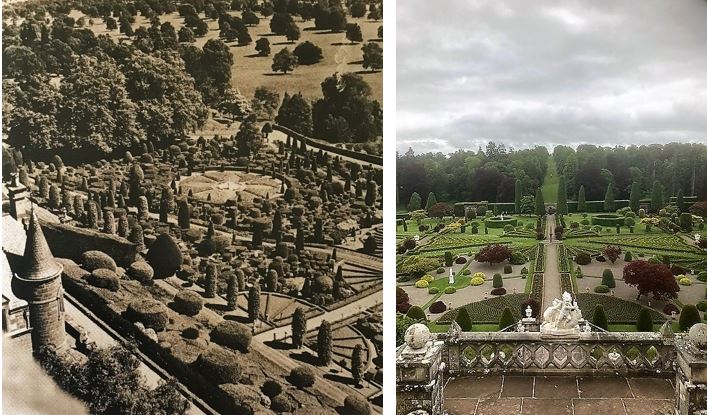
Essentially a nineteenth century recreation of a ‘courtly seventeenth century Scottish renaissance garden,’ the design has as its focus a St Andrew’s cross, with a 1630 sundial by John Mylne placed at its centre. The symmetrical layout is structurally complex, statuary catching the eye at strategic points. The planting adds not only form but patterns of colour, beds being marked out by low hedging. Overall, it is quite extraordinary – and immaculate. Peacocks still stroll the grounds as they did in 1842.
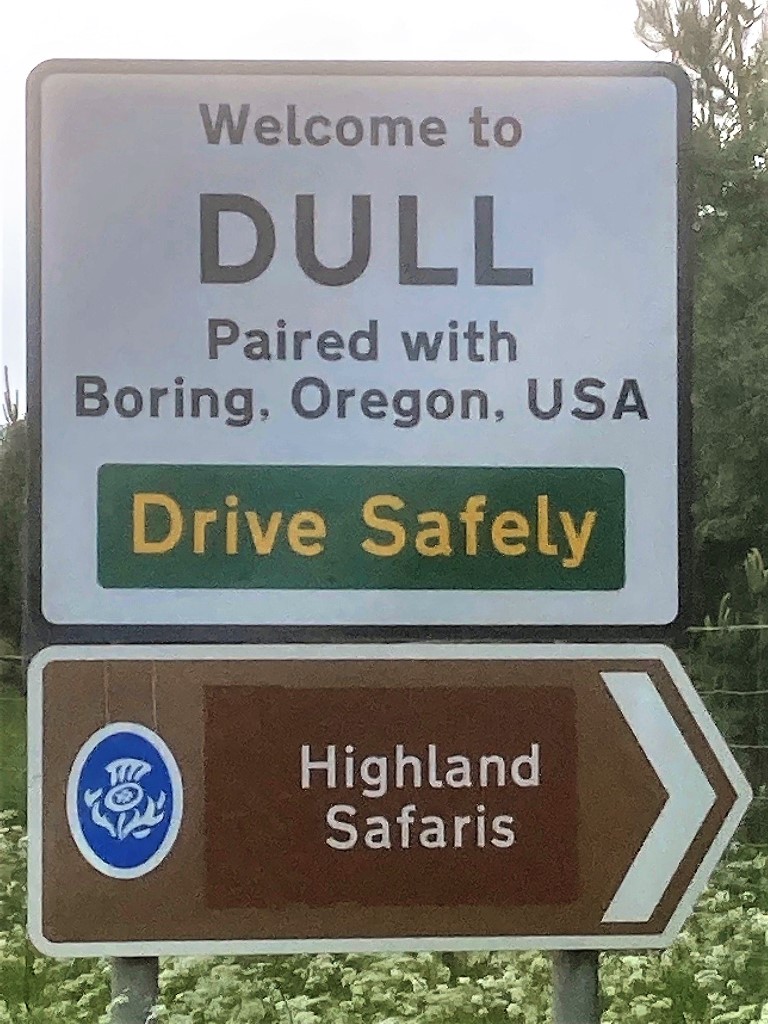
Travelling from Skye to Perthshire, a couple of miles east of this signpost we spotted a somewhat derelict walled garden on a south facing hillside with an adjacent castle. Castle Menzies was closing but we drove up a track to the walled garden. As we were trespassing on the privacy of estate staff dwellings, we did not linger.
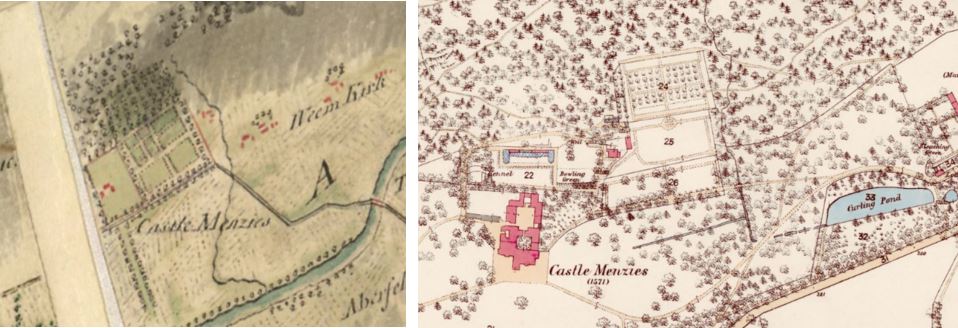
There seem to have been originally three enclosures (or levels) with a central axial stairway but only two now remain. The garden was of some repute. According to The Red and White Book of Menzies (1894), ‘Castle Menzies Gean Trees’ from a very early date obtained celebrity all over the country. So famous indeed were these trees at one time, that their seed was sought from all parts of Great Britain, and large quantities were even sent abroad by request to all parts of the world. These Menzies gean trees were considered the oldest and finest gean trees extant’. The trees even inspired an old Highland song ‘The Castle Menzies Gean Trees’.
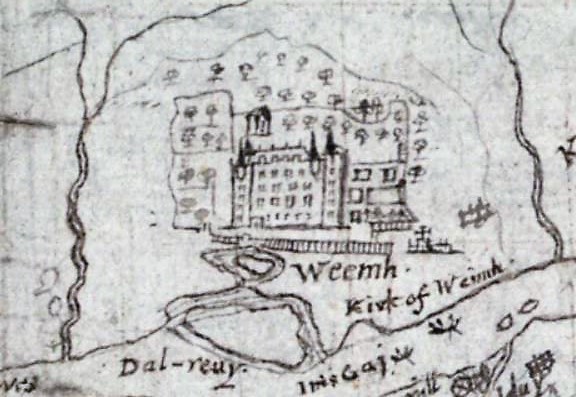
If this late sixteenth century plan is to be taken at face value, and it is borne out by parchmarks showing up in aerial photography, the walled garden was originally sited lower down the hill much closer to the house .
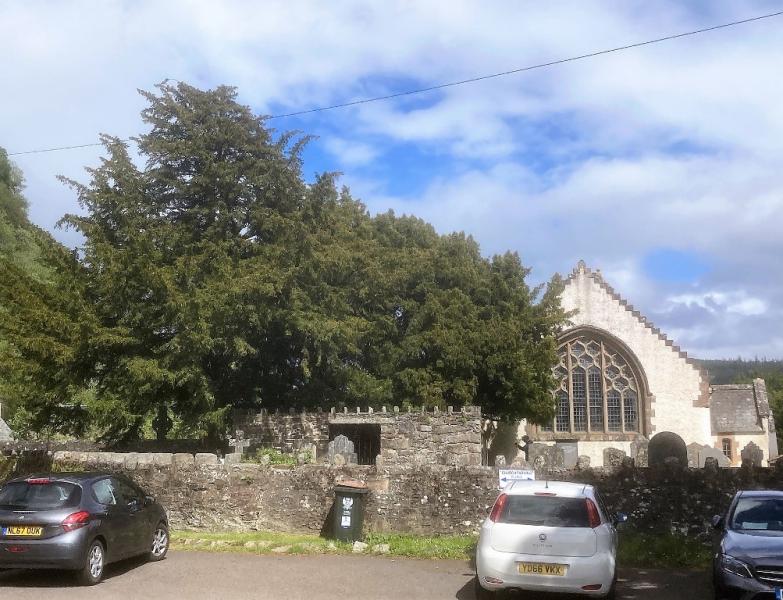
We had earlier seen a sign to the Fortingall Yew. In the churchyard of this quiet hamlet stands a rather battered yew, estimated to be at least 5,000 years old and now walled off to protect it from the vandalism which is threatening its continued existence. Thomas Pennant in A Tour of Scotland Vol.1, published in 1769, wrote at page 103 that, in the churchyard, ‘are the remains of a prodigious yew-tree, whose ruins measured fifty-six feet and a half in circumference.’ The trunk has since split into a collection of smaller growths. No photograph can convey an idea of its original majesty and size, now marked by posts driven into the ground a distance from the present trunk.
Dawyck Garden in the Scottish borders is cared for the by The Royal Botanic Garden, Edinburgh. An extensive arboretum on a hillside, it is most attractive with lofty specimen trees gathered from round the world by the great plant hunters such as David Douglas.
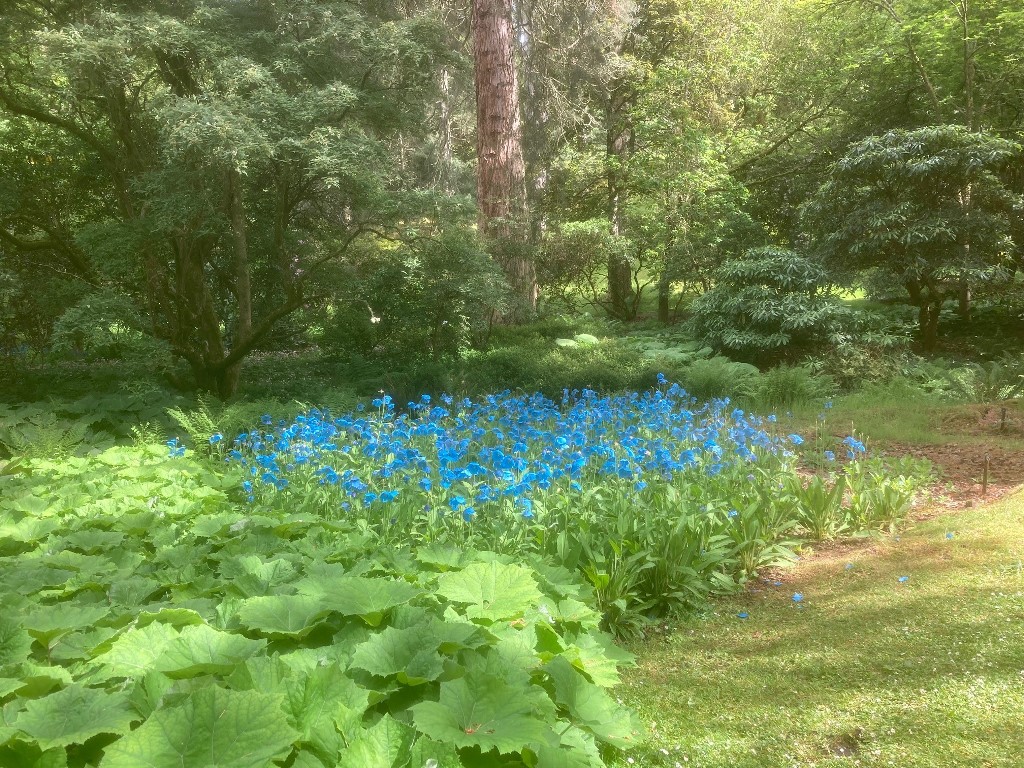
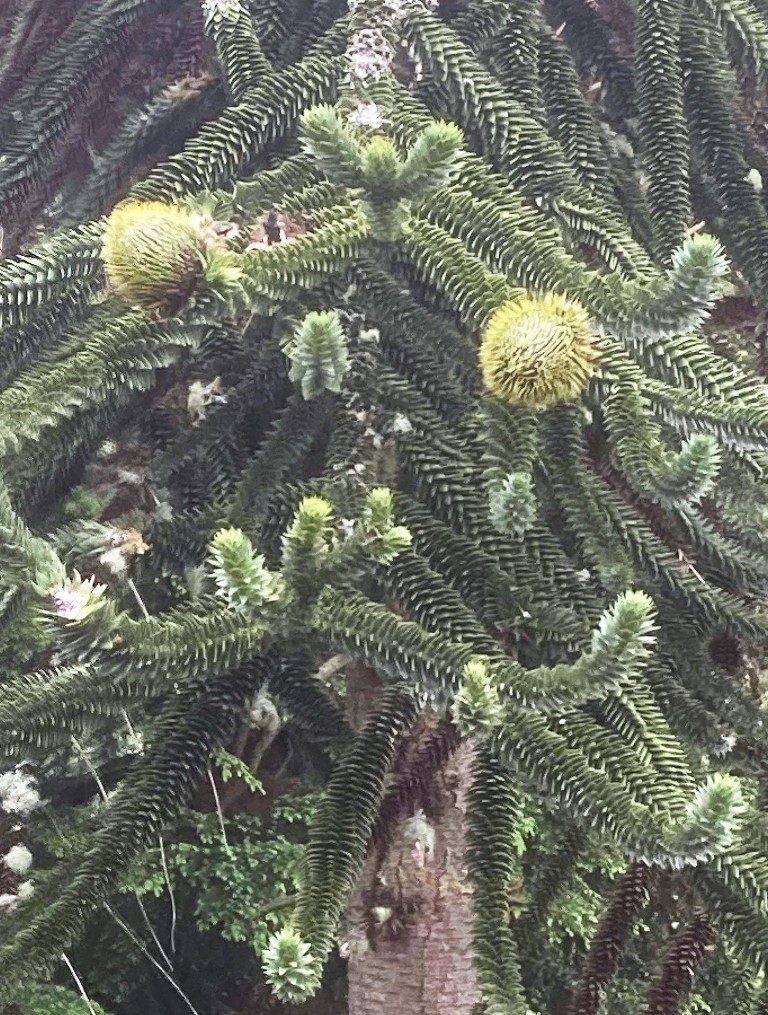
A number of labyrinthine coincidences turned up during my research. David Douglas (1787-1834), from his third trip to America in 1827, brought back the first seeds of the Douglas Fir to this country; he also introduced the Garrya elliptica and the Ribes sanguinem, the flowering currant. He was sponsored by Sir John Murray Naesmith who owned Dawyck which is why there are so many significant specimens of Douglas Fir there. However, the tree bears the name Pseudotsuga menziesii because it was actually discovered by another Scot, Archibald Menzies (1745-1842) who, however, did not bring back, in 1795, any seeds from his four-year circumnavigation on HMS Discovery. He did bring back the first seeds of the Araucaria araucana, the monkey puzzle tree. Menzies was perhaps related to the Menzies of Castle Menzies because he grew up at nearby Styx farmhouse; according to the clan website, he worked in the grounds of Castle Menzies before moving on to the Royal Botanic Garden, Edinburgh.
The Veitch family planted the garden at Dawyck in the seventeenth century, namesakes of the John Veitch who travelled to London in 1768 as a boy and took up an apprenticeship at the Vineyard nursery of James Lee in Hammersmith, later moving to Devon where he founded his eponymous nursery outside Exeter. Lee took into partnership in 1760 a Lewis Kennedy (1721-1782 whose son, John (1759-1842) succeeded to the partnership until its dissolution in 1818. John supplied Empress Josephine with many seeds and plants for her plant collection at Malmaison and had introduced his son, another Lewis (1789-1877), to work there for some years. This Lewis moved on to Drummond Castle as factor. There are many unexpected connections within the gardening world.
Article by Marcus Batty
The map of Drummond Castle, and the Ordnance Survey and the Pont maps of Castle Menzies are Reproduced under a Creative Commons Attribution-NonCommercial-ShareAlike 4.0 International (CC-BY-NC-SA) licence with the permission of the National Library of Scotland. The 1937 view and the Jacob Thomson painting of Drummond Castle are reproduced with the kind permission of the owners. National Trust Scotland have given permission to show images of their properties.
All photos © Marcus Batty