
In mid-August this year, in all that hot weather, I set out with my good friend, Ceinwen, on a week’s visit to South Wales. We based ourselves in Carmarthen town and from there went out on day trips to St David’s, Tenby, the Gower coast and any gardens we could find. A very beautiful garden, one of the finest in Wales they say, is Aberglasney Gardens, only twenty minutes by car from Carmarthen at Llangathen, and set in the lovely Tywi valley.
I have to admit to not knowing about Aberglasney; it is neither RHS nor National Trust but was rescued from terrible neglect, vandalism and dereliction by the Aberglasney Restoration Trust who purchased it in 1999, and began renovation of both the house and the gardens. The final major restoration were the old cowsheds and piggeries which was completed in 2016.
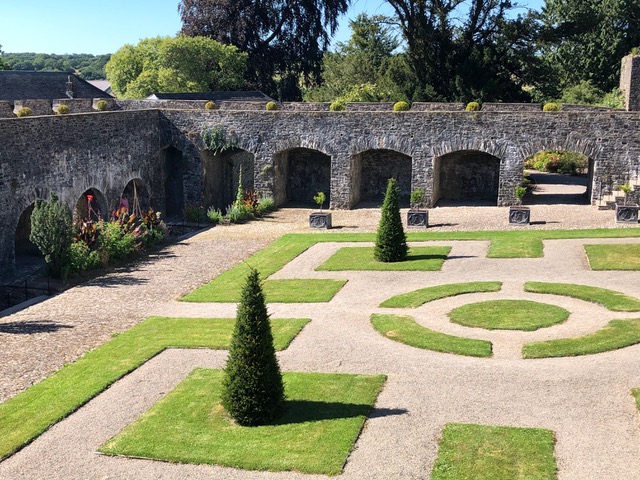
The estate dates from the 1600s when it was owned by Bishop Rudd of St. David’s. Subsequently, it went through many hands with some of the land sold off and finally the estate was abandoned. The earliest of the nine green gardens at Aberglasney is a unique Cloister Garden dating from the time of Bishop Rudd. On three sides of this garden are solid stone walls with a parapet walk above and deep archways below. The fourth side is filled by the house, albeit set back and above the Cloister Garden. Currently, this garden is laid out in geometric patterns of mown grass with clipped trees and paths. Excavations have shown that in the Victorian era there was a circular pool and fountain in the centre of this garden.
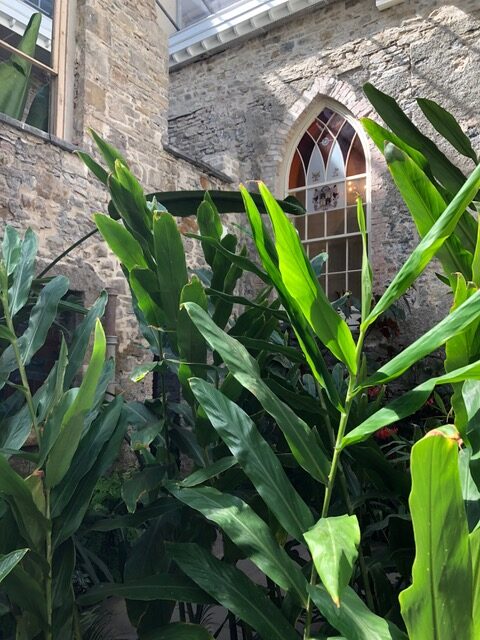
Rather delightfully, in the mansion itself, is what is called a Ninfarium, named after Ninfa, near Rome, where decorative plants have been grown amongst ruins. Here, within the ruined central rooms and courtyard, have been planted a collection of sub-tropical plants which look healthy and dramatic in this unusual setting.
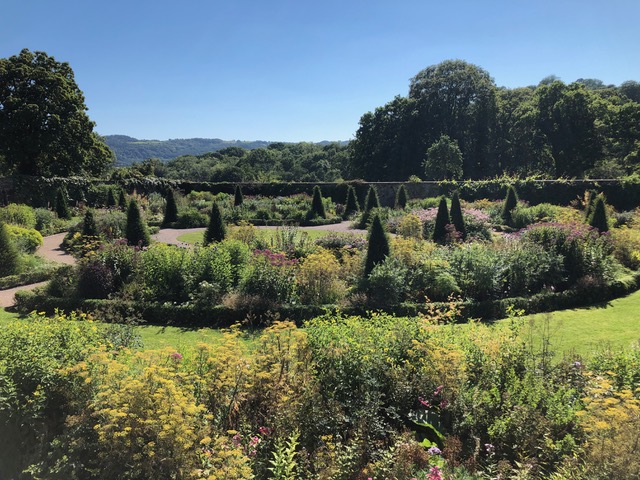
Outside again there is an Upper and Lower Walled Garden, the lower being the kitchen garden although originally both areas would have been used for producing fruit and vegetables. On the wall that separates the two areas are espalier apples and pears. A most striking feature in the kitchen garden is a wonderful crab apple arbour which is apparently stunning at blossom time and full of bees. The upper garden was designed by Penelope Hobhouse and loosely based on a Celtic cross, with trimmed Yew trees growing in concentric circles of herbaceous beds.
Walking away from the house and through the Cloister Garden arches one comes to the Pool Garden and Melon House. The pool is large and rectangular, almost filling this whole garden space, and is fed by rills of underground water. There is a small tearoom to one side, which uses produce grown in the kitchen garden as ingredients in their dishes. This is where the farm building begins and it is said that these walls used to support a huge vine. The view of the Pool Garden from the parapet walk is lovely, especially in the sunshine.
Beyond these formal gardens, on both sides of the house are more gardens: the Sunken Garden, Stream Garden and Jubilee Woodland Garden on one side of the house and on the other the Bishop Rudd’s Walk, Asiatic Garden and Summer Meadow. I saw some of these but not all of them in the afternoon; well, we had to stop and sample the tea and cake in the tearoom. However, it is a house with a fascinating history, wonderful restoration and a truly lovely and interesting garden. It has two little five-star cottages on the estate for holiday lets – which is a very tempting thought.
Article by Maggie Weir-Wilson
All photos © Maggie Weir-Wilson, by permission of Aberglasney Gardens
Aberglasney featured as The Gardens Trust Unforgettable Garden of the Month in April 2021. Read more here.